Showing posts with label workbook. Show all posts

Wednesday, June 3, 2020

Math and Handwriting Practice with Page a Day Math {A Homeschool Review Crew Review}

Disclaimer: I received a FREE copy of this product through the HOMESCHOOL REVIEW CREW in exchange for my honest review. I was not required to write a positive review nor was I compensated in any other way.


Thanks to the Homeschool Review Crew, Harold and Hannah have had the opportunity to work on improving their math-fact fluency and their cursive handwriting with resources from Page a Day Math. 


Page a Day Math offers both physical kits and downloadable digital kits.  All of the materials we received were downloadable files, though some of my fellow Crew Mates were able to review physical kits. As I decided to work on multiplication with the children first, I chose the Multiplication Starter Kit. But, I also want to move into division, so I chose the Division Starter Kit as well. These kits each include 12 books, each with 14 days worth of work. Also included are bonuses. There are flashcards, assessment pages, a progress chart, and two cursive handwriting books in each kit. 

You can also purchase digital flashcards and assessments separately, so I decided to get the flashcards and assessments for addition and subtraction. I figured we could use them for assessing their knowledge and allowing them to practice their math facts. 

What I was really interested in was the opportunity for the children to start working more consistently on their cursive writing. The Multiplication Starter Kit came with I Can Write in Cursive and Beautiful Biology! Cursive Practice, and The Division Starter Kit came with Adorable Adjectives! Cursive Practice and Eats and Treats! Cursive Practice. We were also able to choose any of the other handwriting books we were interested in. So, I chose Scenic States (seeing as we have been learning about American history), Fun Physics, and Cool Chemistry. 

Each of the math books in the kit follows the same format. Each one focuses on the math facts of one number, and each book spans the facts from 0 times the number to 12 times the number, with a final page for review. Each day the child will work on one number's facts on the first page, and review what was already learned on the second page. Technically the pages are front and back, thus the "page a day" name. Of course, that is with the physical book. 

Front:


Back:


As you can see, these books are going to be supplemental to your math curriculum. They don't teach what multiplication and division are, they just allow a child to practice their facts, while working on their handwriting.  And the color-coded flashcards offer even more practice. 


The flashcards need to be printed out, preferable in color and on sturdy cardstock, cut, and folded. After giving the children the first two math assessment pages, I discovered they both needed to start with their facts for 3 and 4. So, I gave them the flashcards and the workbook pages.


I just have them work on a page a day after drilling with the flashcards.


They have actually been spending more time with the cursive handwriting book. I had them start with I Can Write in Cursive, so they could learn all the letters. 


For each letter the child needs to trace a couple of rows of capitals and a couple of rows of lowercase, and then a few upper and lower case pairs.


I actually had the children work on these a little differently, as I wanted us to get through the alphabet and start working on joining the letters into words. 

I gave them three letters a day. They were to do two full lines of each letter, one uppercase, the other lowercase. Then, on the following day, they were given the next three letters. They were to do one uppercase and one lowercase letter (not row, just a single letter) for each of the previous letters practiced, and the full rows of the new letters. In this way, the children have made their way through the alphabet and have started on words. 

Here's a look at a page from the Eats and Treats! Cursive Practice book.


One thing I would have prefered to have had in these books is blank lined pages for the children to practice on. I did have my own to print out, but I found it a bit weird that this program only has children tracing, and doesn't leave room for any free-hand practice on the page.


So, I had the children trace one word, write it a couple of times on lined paper, and bring it to me to check. Then they re-traced the word, and practiced again. If there were any letters they were struggling with, I showed them an example and had them practice the letter, without tracing it.


Harold has really been enjoying writing in cursive. He volunteered to do extra work to perfect them.


Younger children will appreciate the cute Math Squad doggies found throughout the book. In the math books there is a picture of one of them on each page, cheering the child along. And they all join together on the certificate at the back of the book.


In the I Can Write in Cursive book, the Math Squad reminds the child what sound the letter makes when they encourage them to color the picture that starts with the sound. 


And in the themed handwriting books, they ask questions in relation to the words on the page. 

Here's a sample from Beautiful Biology:
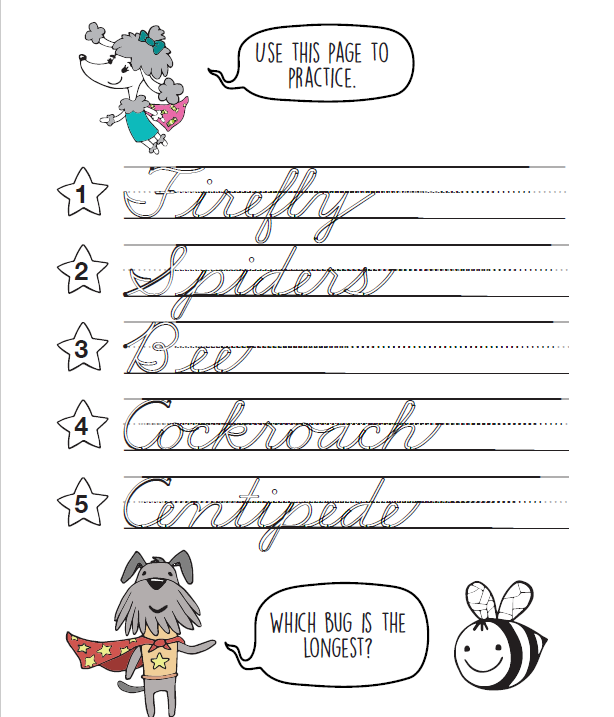

And a sample from Eats and Treats:


Harold really loves these books, especially the handwriting. He says those are his favorite. Hannah isn't a huge fan, though she couldn't really give me a reason. I'm wondering if she thinks they are a bit childish for her, seeing as she is in fourth grade.  However, I appreciate that she has a way to practice her math facts and her handwriting. Maybe the fact that she needs to write the numbers over and over will help her not to write certain numbers backwards anymore.

These are cute little workbooks to help your early elementary child(ren) work on math fluency and handwriting. I think they could be a great addition to your homeschool. And the digital books are awesome because you can print the pages out over and over for more practice if necessary.

You can find Page a Day Math on Facebook, Instagram, Pinterest, and YouTube.

Don't forget to click on the banner below to see what my fellow Crew Mates had to say about Page a Day Math.

Daily Math & Handwriting (Print + Cursive) {Page a Day Math Reviews}

Friday, May 15, 2020

Math Practice with Math Essentials {A Homeschool Review Crew Review}

Disclaimer: I received a FREE copy of this product through the HOMESCHOOL REVIEW CREW in exchange for my honest review. I was not required to write a positive review nor was I compensated in any other way.


Tabitha has taken a break from her normal math curriculum to use Mastering Essential Math Skills Book 2 Middle Grades/High School from Math Essentials. This is the same company that publishes Math Refresher for Adults, which I reviewed a couple of years ago, and some of my fellow Crew Mates have been currently reviewing. I had enjoyed the book I was using, and figured Tabitha could see what she thought about the book that was designed for her age group.


We received the 158-page, softcover book, plus we also have access to free online video lessons. The book is divided into eight topic sections, plus there is a final review section in the back, followed by the answer key. The book concludes with a Resource Center that contains a glossary, important symbols, and charts. 
   

Here is a list of the chapter topics the book is divided into:
  • Whole Numbers
  • Fractions
  • Decimals
  • Percent
  • Geometry
  • Integers
  • Charts and Graphs
  • Word Problems
There is a section at the beginning of the book that explains the 8-step process in using the book. I took this to be more for classroom use, and have actually been allowing Tabitha to use the book independently. 

Each page has the same format. The top of the page has Speed Drills and Review Exercises. 


The idea of the speed drills is that I choose a number to put in the center of the circles and Tabitha gets to work on her math facts for both addition and multiplication.


I'll time her to see how fast she can get it done.


Next she will work on the review exercises if she feels she needs the practice. 

The middle of the page gives helpful hints for that page's lesson. Most of the time it will also show a couple of examples. There are then 12 problems to work out, 2 of which are labeled "S" for sample, or so we assume. And then at the bottom of the page there is a Problem Solving word problem.


Each lesson has a corresponding video lesson on the Math Essentials website.


The lessons are taught by the author of the book, Richard W. Fisher, winner of the "Intel Innovations in Teaching Award."  He will teach the lesson off-screen while the lesson appears on the "board."


Tabitha decided she wanted to start at the beginning of the book because she likes to work through things in order. I agreed with this decision because I wanted to make sure she was confident with all these essential skills that build upon each other. So she has been working through the Whole Numbers and Fractions sections of the book, most days working on one page, other times doing two or even on occasion three. The hints help her to make sure she is on track. 

She's worked through Addition, Subtraction, Multiplication, and Division of whole numbers, plus such topics as Identifying Fractions, Expressing them in their simplest form, adding and subtracting them. 


  Tabitha has enjoyed working through this book and I am glad she is able to ensure she knows all these essential math skills. What sort of surprised me though, was when I learned that the lessons are the exact same lessons, down to each and every problem, as the corresponding lessons in the Math Refreshers for Adults book. I honestly thought the lessons were going to be at a different level as the one was supposed to be for adults. So, technically, she has been reviewing the same material I reviewed two years ago. Granted, the Mastering Essential Math Skill Book 2 book is half the size as it doesn't include the pre-algebra and algebra that is in the second half of the Adult Refresher book. And she does have Speed Drills where the adult book does not. 

I'm not saying that makes it a bad book in any way. I'm just confused as to how one book is marketed for adults and the other for middle grades/high school. Plus, I would think a high school book should still have the pre-algebra and algebra section. I'm finding it difficult to determine what grades the book would be appropriate for. 

You can find Math Essentials on Facebook.

Don't forget to click on the banner below to see what my fellow Crew Mates have to say about the Math Essentials book they reviewed. We had our choice of this Mastering Essential Math Skills Book 2 Middle Grades/High School, Math Refresher for Adults, and No-Nonsense Algebra.


No-Nonsense Algebra, Math Refresher for Adults &  Mastering Essential Math Skills Book 2 Middle Grades/High School {Math Essentials Reviews}

Thursday, March 26, 2020

Math Fun with Riddle eBooks from Math Galaxy {A Homeschool Review Crew Review}

Disclaimer: I received a FREE copy of this product through the HOMESCHOOL REVIEW CREW in exchange for my honest review. I was not required to write a positive review nor was I compensated in any other way.


We had the opportunity to review some fun math ebooks from Math Galaxy. These ebooks allowed the children to practice different math skills as a supplement to their regular math curriculum. 


We received an email with links to five different zip files. Four of these were the bundles of PDF ebooks for the following topics:
  • Whole Numbers
  • Fractions
  • Prealgebra (Decimals, Proportions, Percents)
  • Algebra
The final file was a bundle of Google Slides files for different topics. 

While we received these as bundles, you can purchase each eBook separately from the Math Galaxy Website. Here's a look at the list of eBooks available for each topic:

Whole Numbers:
  • 1 & 2 Digit Multiplication
  • 1-3 Digit Addition & Subtraction
  • 3 & 4 Digit Multiplication
  • Expanded Notation, Order of Operations & Number Patterns
  • Multi-Digit Addition & Subtraction
  • Time and Money
  • Whole Number Division
  • Whole Number Word Problems
  • Length & Area
  • Rounding & Estimating Whole Numbers
  • plus Spelling Word Jumbles Grades 3-5
Fractions:
  • Add & Subtract Fractions
  • Equivalent Fractions
  • Fraction Word Problems
  • Identifying Fractions
  • Length & Area
  • Multiply & divide Fractions
  • Reducing & Improper Fractions
  • Volume, Capacity, Weight & Angles
Prealgebra (Decimals, Proportions, Percents):
  • Decimal Operations
  • Decimal Word Problems
  • Length & Area
  • Percents
  • Ratios & Proportions
  • Understanding Decimals
  • Volume, Capacity, Weight & Angles
Algebra:
  • Algebra Properties & Operations
  • Algebra Solving Equations
  • Algebra Word Problems
  • Exponents, Scientific & Metric Notation & Operations
  • Algebra Linear Equations
These eBooks vary in length from as few as 43 pages, up to 164 pages. There are usually at least 2 sections in each eBook, though most that we have used have had more than two. Additionally, some have extra worksheets for more practice.

Just to be clear, these worksheets are strictly for practicing math skills. There are no lessons to go with them, so your child will already have to know the skills you want them to work on, or you have to be ready to teach it to them. For instance, I didn't realize Amelia didn't understand factoring, so when I printed out some worksheets from the "Reducing & Improper Fractions" eBook that focused on Prime Factors, I found myself trying to explain factors and factor trees to her. I ended up finding a video online that explained it, because I realized my understanding of the topic has disappeared over the years (at least to be able to explain it to someone else).

Though the eBooks don't provide lessons, I was pleased to see that books that required the students to have knowledge of formulas (such as the "Volume, Capacity, Weight & Angles" eBook) provided the formulas at the beginning of the book.

So, how did we use these fun math eBooks?

When I received my email, I downloaded these files with a simple click on the link. To use them, I just have to click on the PDF file and it will open in Adobe Reader, then I print the pages I want the children to work on each day. 

I chose to skip around, letting the children work on different topics throughout the week. We worked mainly from the Whole Numbers Bundle and the Fractions Bundle, though just this week I decided to choose some Decimal Operations sheets from the Prealgebra Bundle as Tabitha had been asking to work with decimals. 

What makes these worksheets fun, is that each page has a riddle that needs to be solved. This is done by answering a handful of math questions and matching the answer with the letter and then entering that letter into the corresponding space in the answer box at the top of the page. 


Each question page has an answer page directly after it, which has its advantages and disadvantages. It is helpful that we don't have to search for the answers in the back of the book. However, as I scroll through, I have to make sure the children aren't looking at the screen otherwise they will see the answers. Also, there are times I would like to try figuring out the riddle, but I scroll and lose the opportunity because I see the answer. Oops.


I started out having the younger children work on simple addition, subtraction, and multiplication.


The older girls worked on fractions because I know they struggle with them. I wanted them to get more practice adding, subtracting, multiplying, and dividing fractions, which also meant they would get practice reducing the fractions.  I definitely appreciated the extra worksheets for this topic.


Then I discovered one of the eBooks had pages I could use with all the children, Identifying Fractions. I had Harold and Hannah work on simple fraction identification with pie charts:


While Tabitha and Amelia worked on identifying fractions using a number line:


I've had Harold and Hannah work on some Expanded Notation sheets:


While Tabitha and Amelia have started working with decimals, just some simple addition and multiplication for now.


You may have noticed that the sides of the paper appear folded on some of these worksheets. Tabitha likes to keep all the answers hidden until she has her work done. She started doing this when we realized sometimes the answers can easily be determined for each question by looking at the answer column. Actually, one of the first worksheets the older girls worked on had this issue because each denominator was only used once:


Though I haven't come across any other sheets that are quite that much of a giveaway, I understand Tabitha not wanting to see any of the answers until she has completed all the questions. 

Other than that little concern, and some of the riddles not making sense to the children, I think these Math Galaxy Riddle eBooks are a great way for students to practice their math facts. 

You can find Math Galaxy on Pinterest.

Math Galaxy also has iOS Apps available from the App Store for multiple grades. As we have Android phones, this wasn't an option for us; however, you can see reviews of these apps along with my fellow Crew Mates' thoughts on the eBooks by clicking on the banner below:

3rd Grade -Algebra Fundametals Math Apps {Math Galaxy Reviews}

Wednesday, October 30, 2019

Improving Multiplication Skills with Channie's {A Homeschool Review Crew Review}


I decided it was time for Hannah to start working on multiplication a bit more consistently this year. She's been working on learning her multiplication facts, but I figured she was up for the challenge of learning how to do two-digit multiplication as well. I honestly don't know if I would have thought of pushing her ahead yet if we hadn't been given the opportunity to review the One Page a Day 2 Digit Multiplication Practice workbook from Channie's Visual Handwriting & Math workbooks. As the workbook is designed for children in 3rd through 5th grade, I decided Hannah (my 4th grader) would be the one working through this review product we received thanks to the Homeschool Review Crew. 


We received this 50-page 2 Digit Multiplication Practice workbook.


This soft cover book has pages that are 8.5" x 11" in dimension, like a normal sheet of printer paper. It is one of eleven different math workbooks Channie's has available for elementary aged students. This is in addition to Teacher Reams and the Dry Erase chart. Plus there are also 27 different products available for handwriting. In fact, it was the handwriting pads that started it all. Channie's was born four years ago when Chan Bohacheff realized her son required something to help him practice his handwriting. Two years ago, we had the privilege of reviewing the Easy Peasy Cursive Workbook. Hannah was again the recipient of that review product. If you would like to see what we thought of that workbook, I invite you to check out my review. 

Like the handwriting workbooks, Chan Bohacheff has incorporated different colors to help visually guide the student in the math workbooks. There are actually three different kinds of pages.

The first 14 pages have only a one-digit multiplier.  The area where the student is to work out the problem is white, then green, then white again.


As you can see, each section is actually broken up into little squares with plenty of space for a child to write the number. The columns are divided by double lines instead of single lines. The tens and ones columns are labeled at the top of the page. The book follows a logical order in that on the first page the child is multiplying every problem by 1, on the second page the child is multiplying by 2, and so on for the first nine pages. Each of these nine pages also follows the pattern of the multiplicand (the first number) increasing by tens from 10 to 90, then back to 10, and from there increasing by 1's from 10 though 19. The page finishes up by having the child repeat several of the same problems from earlier on the page. 


Pages 10-14 give a child practice with random numbers, though I did just notice that pages 10 and 11 are identical.


After practicing multiplication with problems with a one-digit multiplier, the book moves on to two-digit multipliers. These problems now have three colors. In addition to white and green, there are now blue sections. As a child multiplies, they are aware that when they multiply by the number in the ones column they put the results in the green boxes, and when they multiply by the number in the tens column they put the results in the blue boxes. This helps to keep the child from getting confused, especially with the numbers that have to carry to the top. 


The children start out just multiplying by 10 for a full page, then move onto multiplying by 11 for a full page. Then there is a page that mixes the 10's and the 11's, before the book moves on to a more random selection of multipliers. There are 26 pages that follow this format. 

Then the child gets to practice without the colors for eight pages. 


The book concludes with a two-page answer key.


How did we use this multiplication practice workbook?

Well, at the beginning I had Hannah work on it one page a day for a few days a week. I had her use it independently, but then it came to my attention that she didn't quite understand the correct way to be using it and she was struggling. I admit, I would have noticed sooner if I had checked her work every day, but she hadn't expressed any concern or confusion, so I thought she understood. Once I realized she was having problems, I started guiding her through the problems at the beginning of the page, reminding her that there is a multiplication chart on the inside of the front cover,


then letting her go off on her own, if she so chose, to finish the page. But I made sure to check and have her fix any mistakes right away. 


Obviously, this means we didn't get quite as far through the workbook as we could have. However, I feel confident that she now knows what she is supposed to do. At least with one-digit multipliers. We'll be moving on to two-digit multipliers next.

There are a couple of things I did want to mention.

I was a bit surprised that there is no green box on the top of the tens column for children to carryover the number, if needed, on pages with one-digit multipliers. I think that reminder would have helped Hannah, made her realize she was supposed to do something with that digit that belonged in the tens column.

Also, we have found the best way to use this workbook is to take out the page as we are using it and store it in a folder.


There are a couple of reasons for this. First, the pages seem to fall out quite easily, and I don't want to get them lost. Second, when a child flips up the sheet to get to the page on the back of it, the child either needs to fold the book back or reach over the bottom page to work. Folding it back is probably what causes the pages to fall out now that I think about it. But, obviously it would be a bit uncomfortable to reach over the bottom page to work.

Maybe the book was purposely made so that the pages can be taken out for ease of work and are meant to be stored in a folder. Personally, I do prefer to keep a workbook intact if at all possible. Less chance for my children to lose their work.

Even with those little concerns, I think this is a great workbook for children to work on their multiplication skills, especially if they are struggling. The separate colors help to clarify the steps. And they can focus on perfecting these steps even if they don't have all their multiplication facts memorized, as they can use the multiplication chart to make sure each step has the correct answer. If your child  needs help with their multiplication skills, and more clarity while working out these steps, I would definitely advise looking into the One Page a Day 2 Digit Multiplication Practice Workbook from Channie's.

You can find Channie's on Facebook and Instagram

Don't forget to click on the banner below to see what my fellow Crew Mates had to say about this and a few other great Channie's products. 

You will find reviews of 


Alphabet, Number & Sight Word Dry Erase, Neat Numbers & Page a Day 2 Didgit Multiplication. {Channie's Visual Handwriting & Math workbooks Reviews}

Crew Disclaimer
Related Posts with Thumbnails