Showing posts with label science. Show all posts

Friday, November 6, 2020

Digging Into Archaeology with Drive Thru History® Adventures {A Homeschool Review Crew Review}

Disclaimer: I received a FREE copy of this product through the HOMESCHOOL REVIEW CREW in exchange for my honest review. I was not required to write a positive review nor was I compensated in any other way.


We had the pleasure of being able to review Bible Unearthed thanks to the Homeschool Review Crew. This is a course from Drive Thru History® Adventures that is helping us to really dig into archaeology and the importance of how it helps us to understand the ancient world, especially things from the Bible.


We were granted lifetime access to this 12-part digital series.  


The course is geared toward children in upper elementary grades and older. This means the older girls were the children who I felt would get the most out of it. However, one of the reasons I really wanted to review this course is because I am quite interested in ancient history (I have been since I took a course in college), and I love the thought of checking out the accuracy of the Bible. Another reason I was so interested in this course is because we have watched other Drive Thru History® videos in the past, and have really enjoyed them. 

This course features Dave Stotts, who is the host of Drive Thru History®. We loved following on his journeys around the Bible lands. Joining him are Dr. Titus Kennedy, an archaeologist, and Randall Niles who works with Mr. Stotts as a writer of the series. They gather together in their secret lair to teach us through the discussions they are having. They alternate between asking and answering questions, sharing information on a chalkboard, showing off artifacts, sharing slides, and watching videos of Dr. Kennedy in the field. 

As they mention in the first episode, when we are watching the Drive Thru History series, we are getting the archaeology second hand. So, they wanted to have a chance to really get into the archaeology itself. 

When I first logged into the course, I was able to check out the welcome information and the course guide, which helped me decide how we were going to make our way through the course.

Here is a list of the twelve episodes we are working through:
  1. What is Archaeology?
  2. The Impact of Archaeology
  3. Locating Archaeological Sites
  4. The Life of an Archaeologist
  5. What's Being Discovered Today?
  6. Archaeological Mysteries
  7. Top Discoveries in Bible Archaeology
  8. Getting Involved with Archaeology
  9. Trends in Archaeology
  10. Weird Archaeology
  11. Accidental Discoveries in Archaeology
  12. What's Left to be Discovered?
As was to be expected, they started out by defining what archaeology is. Dr. Kennedy is the teacher in the course, the one with the PhD. So, he is quite serious while giving the lessons. And he goes into details using more technical ideas at times. Such as going into the fact that the word archaeology comes from two Greek words which mean "Study of the Ancient." He then goes on to give a long definition, which Mr. Stotts asks to be given in easier to understand terminology. The definition is ultimately boiled down to, "Digging up old stuff." We had to chuckle at that. Where Dr. Kennedy is the serious teacher, Mr. Niles acts as if he is the attentive student eager to learn, and Dave Stotts is the mischievous one.

We are given a brief look at the history of archaeology. They discuss how it started as people who were treasure hunting or even grave robbing. However, during the Renaissance period, there became a real interest in learning about the past. And the discipline we know as archaeology today was birthed out of these "antiquarians."

They go on to discuss some early archaeological excavation sites, such as Pompeii (which we have learned about in our core curriculum) and Troy (which is the topic of the book that captured Dr. Kennedy's attention when he was younger). 

Dr. Kennedy shows us many artifacts. Here he is discussing the Rosetta Stone (of course, this is just a small replica):


This was fun to watch, because we had studied Ancient Egypt a few years ago, and learned about it, and the importance it had in helping us to understand Egyptian hieroglyphs. 

Looking through the slides of some different archaeological sites was quite interesting as well. Some of the places we had learned about, such as Pompeii, Troy, and the Great Pyramids, but we also learned about some new places, such as the Minoan Palace of Knossos in Crete. 

Here's the slide he showed us of Pompeii:


As we have been making our way through the course, it has been impressed upon us that archaeology is so important because it helps us to better understand the historical context of the Bible, and to understand the historical narratives. We can see the reliability of the Bible, which was thought to just be mythology or propaganda. And when archaeologists have gone in, hoping to DISprove the Bible, they have actually found evidence of it being true. 

It goes on to explain that archaeology helps to fill in the gaps and illuminate passages. We get to see important inscriptions that prove the people, such as King David, actually existed, and events in the Bible actually happened, such as the wandering of the Israelites around 1400 BC. 


They also show and explain different maps of excavation sites.


It was definitely quite interesting learning about the specifics that they have to record while out on the field.


I really enjoyed the clips of Dr. Kennedy out on the field. I think that is because it reminds me more of the Drive Thru History® videos we are used to, with Dave Stotts wandering around in different areas to teach us about them. I admit, this Bible Unearthed course is a bit different than we were expecting, knowing how the other Drive Thru History® series have been. Don't get me wrong, that doesn't mean we don't like this course. It was just. . . different. I do think the children don't have as much interest in it as I do. However, we will continue to make our way through it.

I've really enjoyed learning about the different artifacts found, artifacts that help us prove that the Israelites were in the land of Canaan, and that King David actually existed as an important historical figure. I was intrigued by the finding of royal seals and steles. Proof that the events in the book of Daniel actually happened. I found it interesting that they are still looking for the exact location of Emmaus, mentioned in the New Testament. There is just so much out there that is being discovered, and is helping to confirm, instead of disprove, the Bible. 

We aren't just getting to watch these amazing videos though. With the Drive Thru History® Adventures, we get additional resources, such as Dig Deeper articles, and worksheets which include summary information and other details (some not included in the videos), plus questions for the children to answer, Bible passages to read, and optional activities, such as mapping an archaeological site, making a time line, and using geography to locate an ancient site.  


I have been watching the videos with the younger children, but it is the older girls who have been working on the worksheets. I have them watch a video each week, and then they are to read the worksheet information and answer the discussion questions. They have mentioned that they have trouble finding the answers at times, and they haven't really been interested in the Digging Deeper articles, but I have found them quite intriguing. 

Amelia has stated that she loves they watching the videos has given her an idea on a story to write. Plus, she said, "we have actual evidence to prove people wrong" when it comes to the events in the Bible.

As we go through the course, I am looking forward to learning about the accidental discoveries and what is left to be discovered. 

This really is a great course, and one I highly recommend. However, if you are used to the other Drive Thru History® series, just be aware that they aren't quite the same. 

If you haven't viewed any of the Drive Thru History® series, I invite you to read my review of Drive Thru History® - The Gospels.

You can find Drive Thru History® Adventures on Facebook, Instagram, and YouTube.

Don't forget to click on the banner below to see what my fellow Crew Mates had to say about Bible Unearthed. 


Friday, October 9, 2020

Relaxed Learning with Lessons & Unit Studies from NatureGlo's eScience {A Homeschool Review Crew Review}

Disclaimer: I received a FREE copy of this product through the HOMESCHOOL REVIEW CREW in exchange for my honest review. I was not required to write a positive review nor was I compensated in any other way.


We have always been relaxed in our homeschool style, but lately, we've been even more so. I love being able to find different curriculum that allow us to study in a relaxed way. For the last several weeks, Tabitha and Amelia have been using the NatureGlo's eScience MathArt & Science Course Bundle from NatureGlo's eScience. Gloria Brooks, who holds a BA in K-12 Education, is the creator and teacher for these courses. She is a relaxed eclectic homeschool & unschool coach & teacher who has been teaching/facilitating homeschoolers and unschoolers from around the world for the past nine years. Plus she has over 20 years of teaching and child self-directed learning experiences.


As members of the Homeschool Review Crew, we were given a full year's access to 25 different MathArt and Science courses that had been bundled together. When the children log into our account, they can click to see all the courses available to them. Here's a small glimpse of what they have available.


There are science courses in Botany, Bubbleology, Geology, Herpetology, Invertebrates, Mammals, Marine Biology, Marine Reptiles, and Marine Zoology. 

The MathArt lessons include the following lessons: Introduction to MathArt, Math Connections with the Real World, Intro to Patterns & Shapes, MathArt in Ancient Cultures (which we had reviewed a couple of years ago), MathArt in Arts & Science, MathArt in Patterns in Nature, MathArt in The Geometric Beauty of Snowflakes, plus a look at the Life and Mathematical Art of both Leonardo da Vinci and M.C. Escher.

Some of these courses are just one lesson long, while there are others that span 2-6 lessons or even 3 or 6 weeks. And the 1-lesson Unit Studies will take longer than the 1-lesson classes. 

In order to use this site, we have to have internet access. A printer could come in handy for printing out such things as the study guides; however, a student can also use a notebook to take notes and answer questions, or could type in answers in Adobe. 

The girls started out by studying independently, finding topics they were interested in. Amelia chose to go through some 1-lesson courses. She watched the videos for Exploring the Giant Redwood Trees, Intro to Rockhounding, and Introduction to MathArt. Tabitha had been working on Tide Pool Communities when Amelia joined in and they continued together.  I've allowed the girls to work together on their lessons if that is what they choose to do; however, I could make them each their own student accounts, so their individual progress could be kept.

Let's take a closer look at one of the courses the girls worked on: Tide Pool Communities. 


For these lessons there are videos to watch, plus there are downloadable PowerPoint slideshows and study guides to help guide the student in the lesson. In the video, Gloria teaches the lesson with the information found on the PowerPoint slides.


Here's a screenshot of the slide being discussed:


Another fun aspect of this course is the interactive activity. I remember Amelia really enjoyed these when we were going through the MathArt in Ancient Cultures course. From that course we know some of the interactive activities allow you to click through to more information. However, in this lesson, clicking on the pulsing dot or the name of the item would bring up a box with more information about it.

As they went through the course, they wrote notes and then answered the questions from the study guide right in their notebooks.


The girls also used the Quizlet to review the terms. There are several different options available.


These are the different Study Modes:
  • Match - Student is timed matching the word/phrase to the definition
  • Learn - Student answers multiple choice questions to learn the material
  • Test - Student answers various types of questions and receives a grade
  • Flashcards - digital flashcards showing word/phrase on one side and picture plus definition on the other
  • Spell - student sees the picture with the definition, hears the word/phrase, and has to type it out correctly
This one lesson class was quite informative, even mom enjoyed learning new information about tide pools. 

I had seen how fast the girls had completed this lesson, so I was confused as to why another one lesson course was taking them longer. It was then that I realized there is a difference between the one lesson class and the one lesson unit study. 

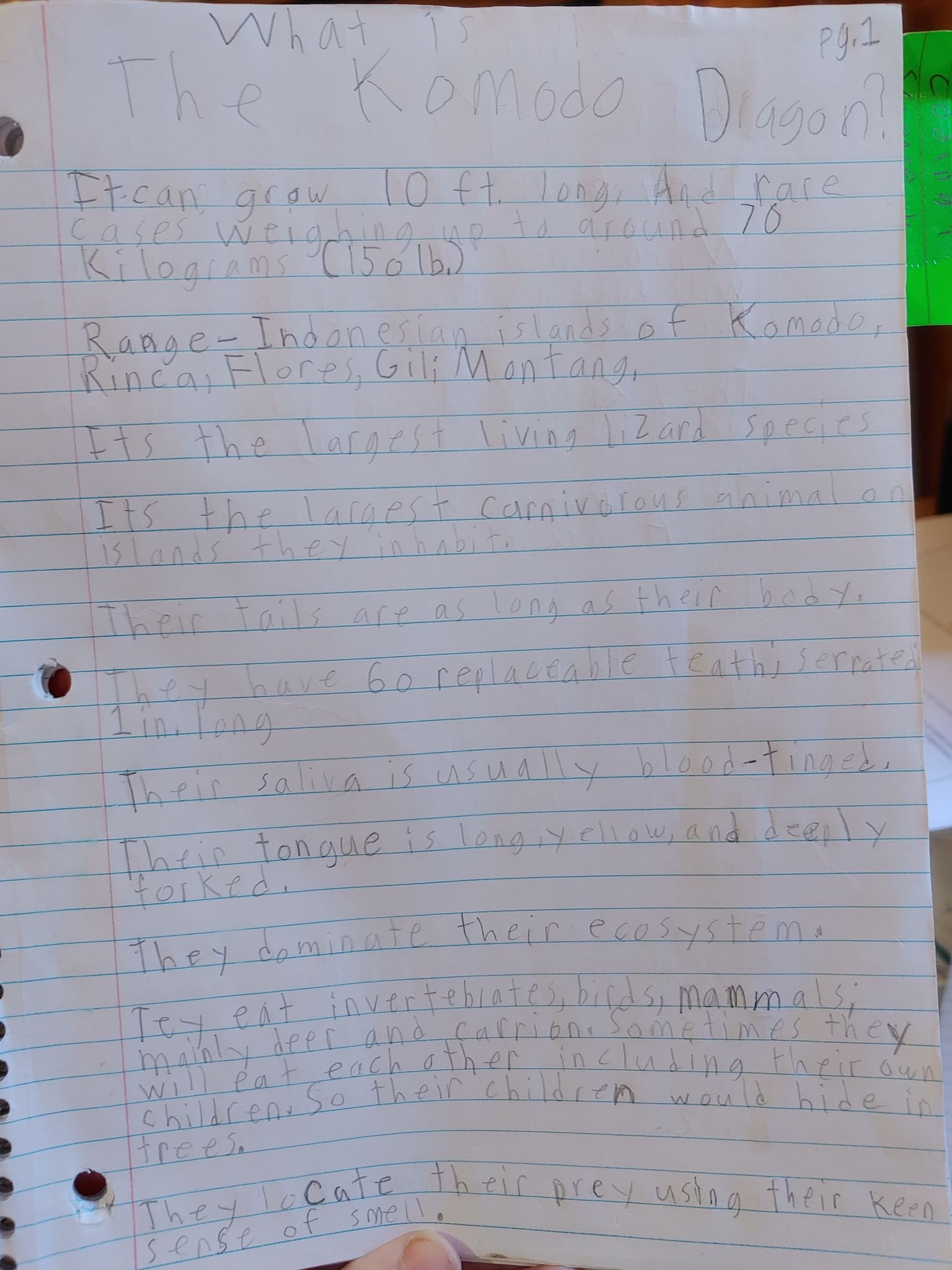
The girls were also interested in learning about Komodo Dragons. This course is a one lesson unit study. 


This unit study contains seven different parts which include various subjects. Students will learn about Komodo Dragons and also study history, geography, art, literature, and creative writing.


The girls are currently working through the main lesson slideshow and taking notes. 


There are then some really interesting facts about komodo dragons they can read about, there are even some videos for them to watch.


The interactive activity from this course was the map activity.


Plus there is a video to watch to draw a komodo dragon. 
There are so many intriguing courses that the children can choose to take. I love the combination of Gloria teaching in the videos with the slides and the interactive aspects that make even online learning hands-on. And I have always loved unit studies, being able to incorporate multiple subjects in our lessons. The girls are also enjoying being able to delve deeper into topics that are of interest to them. 

I do think they are enjoying these science topics more than the did the MathArt course we reviewed a couple of years ago. Of course, they are also older now. When we reviewed it last time, the girls were at the low end of the recommended age range. Now they are 12 and 13 years old, and I think better able to take notes and pay focus on what is being taught. 

Whether you choose to supplement your current curriculum, or use the courses as a full curriculum, I highly recommend NatureGlo's eScience for your children to learn not only science, math, and art, but to be able to incorporate multiple subjects. 

You can find NatureGlo's eScience on Facebook, Twitter, Instagram, Pinterest, and YouTube.

Don't forget to click on the banner below to see what my fellow Crew Mates had to say about NatureGlo's eScience.


Thursday, July 30, 2020

Experiencing Biology with Journey Homeschool Academy {A Homeschool Review Crew Review}

Disclaimer: I received a FREE copy of this product through the HOMESCHOOL REVIEW CREW in exchange for my honest review. I was not required to write a positive review nor was I compensated in any other way.


The younger children and I have enjoyed using a new science program for the last several weeks. This Experience Biology: Elementary program is being created by Luke and Trisha Gilkerson, as is an Experience Astronomy: Elementary program, both of which are a part of Journey Homeschool Academy. They also have an astronomy course for high school.


We have lifetime access to this course that is geared toward children ages 6-11. Though the main portion of the program is online, the program has been designed with different learning styles in mind. While online we watch the main video lesson and the memory video, but there are also book recommendations, hands-on activities (very important in our homeschool), memory work, copywork, and quizzes. So, a person who is interested in using this program would need a computer with internet access, a printer, access to the recommended (but not mandatory) books, and supplies for activities (there is a section where you can find the complete activity supply list, plus they are listed in each lesson). 

When I first log into the program, I come to my dashboard.


From here the children or I click onto the Experience Biology: Elementary course.


Luke and Trisha Gilkerson join us onscreen to teach the lesson.


They are planning for the program to have a total of 30 lessons. If you do one lesson a week, the course will last an entire school year.

To the left of the screen you will find the list of lessons. When you click to expand it will reveal the lesson, memory video and the link for the extra material. This extra material includes the hands-on activity instructions plus any needed printables for the activity, copywork pages in print and cursive, and flashcards for the memory work.

Here is a list of all the lessons that have been added to the program so far. 
  • Lesson 1: What is Life? 
  • Lesson 2: The Building Blocks of Life
  • Lesson 3: The Secret Code of Life!
  • Lesson 4: Fueled Up!
  • Lesson 5: What's in a Name?
  • Lesson 6: Biomes Everywhere!
  • Lesson 7: Itsy Bitsy Teeny Tiny Creatures
  • Lesson 8: The Junk Drawer Kingdom
  • Lesson 9: The Fungus Among Us!
  • Lesson 10: What is a Plant?
  • Lesson 11; The Wide World of Plants
  • Lesson 12: Mean, Green, Energy Making Machine
  • Lesson 13: Roots and Shoots
  • Lesson 14: The Reason for Flowers
  • Lesson 15: It Begins with Seed
  • Lesson 16: Amazing Animals
  • Lesson 17: Silly Sponges
  • Lesson 18: Wiggly Worms
  • Lesson 19: Majestic Medusas and Patient Polyps (Cnidarians)
As we work our way through the lessons, we can mark them complete.


Luke and Trisha do a great job teaching the individual lessons. I love that they also take us "Back in Time" to learn the history behind the lessons. 


I especially like that they use props from the Back to the Future movies (the Delorean and the Flux Capacitor make an appearance in each lesson).


So far, while going back in time, we have learned about some interesting scientific history facts.

In Lesson 1 we went back to the beginning of creation.
In Lesson 2 we went to the year 1665 and learned a bit about Robert Hook and his homemade microscope and his work in discovering and naming cells.
In Lesson 3 we found ourselves in Cambridge in the mid 1900's with James Watson and Francis Crick discovering DNA.
In Lesson 4 we learned about Jan Baptista van Helmont who lived in the early 1600's in Belgium. Did you know back then there was the belief that trees ate the soil to grow?
In Lesson 5 we went to the year 1732 and learned about Carl Linnaeus and his exploration of plants, animals, and minerals as he worked on a classification system.

I can't wait to see where and when we go next.

After watching the lesson video, the children watch the memory video. Luke and Trisha will tell the students what specific details out of the lesson they want them to focus on and memorize. And we have flashcards to help us do just that.


 Plus there are different quotes or Bible verses that the children get to use as copywork.

I have the children work on both their print and cursive.


I love that Harold has been particularly excited about practicing his cursive. It has improved quite a bit during this past month.


What is really exciting is that the program also includes a hands-on activity with every lesson. 

Their favorite activity was creating DNA out of licorice, toothpicks and colorful mini marshmallows.


But they've also colored different types of cells, following the instructions which also gave descriptions of each of the different cell parts.


The did some cutting and gluing while figuring out whether the picture was a producer, consumer or decomposer.


And they have used cute little monster/creature cards to work on their classifying skills. I loved that they both had some unique ways of sorting their creatures.


And we finish up our week by having the children take the lesson's quiz. There are usually 7-9 questions, either multiple choice or true/false.


I love that these lessons have a variety of ways for the children to learn, and that it is very flexible. The children are introduced to some detailed information, but aren't expected to remember everything they are introduced to. And because we have lifetime access, we can go back through the course when they get older, to have them work on learning more information, if we so choose. Maybe at that point we will add in the recommended books. Unfortunately that was something we couldn't do this time because of limited library access due to covid-19. However, there was enough information given in the videos, that I wasn't concerned about not having the books. 

I appreciate the resources that are provided, such as the quiz answer key (in case mommy isn't quite sure what answer they are looking for), a complete recommended reading list given in both lesson order and alphabetical order, and a complete supply list for all the activities. 

This is a wonderful science curriculum for elementary aged children, and I look forward to working through the remainder of the course in the coming school year. I highly recommend it for your homeschoolers.

You can find Luke and Trisha Gilkerson on Facebook and Instagram on the Intoxicated on Life pages.

Don't forget to click on the banner below to see what my fellow Crew Mates had to say about the different science courses available from Journey Homeschool Academy.


Experience Biology: Elementary Level, Upper Level and Experience Astronomy: Elementary {Journey Homeschool Academy Reviews}
Related Posts with Thumbnails