Showing posts with label curriculum. Show all posts

Wednesday, August 26, 2020

A Look at 3rd Grade Entire School Year Curriculum by Homeschool Easy {A Homeschool Review Crew Review}

Disclaimer: I received a FREE copy of this product through the HOMESCHOOL REVIEW CREW in exchange for my honest review. I was not required to write a positive review nor was I compensated in any other way.


If you are looking for an easy-to-use homeschool curriculum that includes all the core subjects, you may just want to take a look at Homeschool Easy. Thanks to the Homeschool Review Crew, I've had the opportunity to review the 3rd Grade Entire School Year Curriculum. 


Homeschool Easy is a great resource for homeschooling parents. As I mentioned above, it includes all the core subjects. As a parent you will receive a link so you can download the entire year's curriculum. There are nine main files included in this zip file. You then click on each subject's file to bring up the menu for the different topics, either broken down by months or weeks. There is enough material to span the entire school year, 32 weeks or 8 months. 

Here are the core subjects:
  • Book Reading
  • Grammar
  • History
  • Math
  • Reading
  • Science
  • Writing
The other two main files are instructional files:
  • How to Use Homeschool Easy - 3rd Grade
  • 3rd Grade Overview
In addition to these downloadable files, you will need a printer to print out the materials, and internet connection to watch the videos. Of course, normal school supplies will be needed, such as pens, pencils, a binder to store the printouts, etc. And you will also need materials for projects in science and history. 

When it comes to how to use this curriculum, it is quite simple. You print out as much of the materials as you want to at a time for each subject. Personally, I think a week at a time would work well, which is what the creators of Homeschool Easy recommend. Hole-punch the papers and put them in a binder, or binders. For grammar and math, the parent is to demonstrate the concepts before having the child work on the worksheets. There are also video links included for the students to view. For reading there is a weekly word list to read through plus flashcards, in addition to the worksheet activities. For book reading you need to either obtain a copy of the chapter book or see if the book is available at the online library they link to. Whether the parent or the child reads the book is up to the parent to determine, based on the child's reading level. For science and history there are links to videos to watch, in addition to worksheets to fill out and projects to complete. 

Let's take a closer look at each component of the curriculum. 

Book Reading

Each month your child will be reading two chapter books at the rate of one or two chapters a day. There are a variety of books that will be read during the year, some of which I've never heard of, while others are classics. For example, the first month children are reading Bad Kitty School Daze by Nick Bruel, plus Mr. Popper's Penguins by Richard Atwater. Later in the year they are reading Babe the Gallant Pig by Dick King-Smith and Mrs. Piggle-Wiggle by Betty MacDonald.

There are reading comprehension questions in the form of "What?," "Why," "How?," and "Describe" questions, so children can be looking for details as they read. Each week there are also vocabulary words to define, plus the student is to write a definition. There are about eight words each week, so the student could spread them out by doing a couple a day. 

Reading Comprehension:


Vocabulary:


Grammar:

There are 33 files in the Grammar folder. The first file contains the answers to the questions for every week, plus it includes the links to the video lessons. The 32 weekly files contain daily worksheets on various grammar topics, starting with different kinds of sentences at the beginning of the year, and going through lessons on subjects, predicates, run-on sentences, compound sentences, commas, verbs, contractions, pronouns, adjectives, and verbs. 

When a new concept is taught, there is a box at the top of the page that explains it. Plus, as I mentioned before, there are video links for further instruction. Then the children will work through different kinds of activities such as labeling, adding punctuation, circling correct answers, and writing sentences showing the concept learned.


History:

Children will be focusing on American History and Patriotism. There are eight separate folders for the school year, each one includes 5 files, a guide, which includes the links to the videos, answers to the worksheet questions, and instructions for each week's project. 

The year starts with a month on patriotic symbols, such as the American Flag, the Statue of Liberty, Mount Rushmore, and the White House. Then there are lessons on American History that range from Native Americans through the Pilgrims and colonial times, to the Revolutionary War, early America, American inventors, Westward Expansion, the Civil War, the two World Wars and modern history, looking at presidents such as John F. Kennedy, Richard Nixon, and Jimmy Carter. Children are to watch videos, answer questions, and then do weekly projects on some aspect of what they learned, usually some sort of poster board project or writing project. 


Math:

Math focuses on traditional math and number sense. There are worksheets, manipulatives, and flashcards included in the printable section, plus links to the video lessons. Children work their way through place value, reading & writing numbers, expanded form, and then work on comparing numbers and ordering them before moving into addition, subtraction, multiplication, and division. They have manipulatives to help them work out the problems. Children will also work on fractions, decimals, and measurement. There is simple geometry with lines, angles, triangles, and polygons. Plus they will work on perimeter, area, and volume. The year ends with learning about charts and time. 

Here are some examples of the worksheets and the manipulatives that go with them.


Reading:

The reading lessons give children phonics-based wordlists each week. The children are to read the words and then read sentences with the words included in them. There are flashcards included for children to practice reading the words, plus children demonstrate that they understand the meaning of the word by circling the correct word that should go into the sentence on the worksheet. There are also crossword puzzles and word finds each week. Finally, the children are to read a couple of passages and answer reading comprehension questions. 

Word List:


Flashcards:


Fill in the Blank/Understanding the meaning of the word


Crossword Puzzle/Spelling


Word Search/Spelling


Science:

As with the history lessons, there are videos for the children to watch on different science topics, and then they are to answer questions on the worksheets. Children will learn about the solar system for three months, then move into lessons on Energy and Light for a month. From there they will focus on Adaptations of different kinds of environments. Then they will look at animals in these environments.

And, as with the history lessons, there are projects to do. Though there aren't always specific details on what they are to do included in the curriculum. They are to get ideas by watching videos. 

Writing:

Each week there are two writing prompts for the children to complete. As there are other opportunities for children to practice their writing throughout the curriculum, I would probably allow Harold to choose one each week to work on. I appreciate that their is a teacher guide included that explains what should be expected of third grade children when completing these writing projects. It is good to know that 6-7 on-topic sentences are sufficient and that they should focus on the grammar they have learned. 

Here are some examples of the word prompts:

Did you enjoy your summer? Why or why not?
If you could change one thing in your room, what would you change? Why?
Pretend that you are a grown adult. You want to buy a house. Describe what you would want in the house. How would this house look?

What are my thoughts?

I love that Homeschool Easy includes all of the core subjects. However, I did realize that parents might come across the problem that a child isn't always right on grade level in the different subjects. That is one of the benefits of homeschooling, children can work at their level. For our family, I'm looking specifically at the math, and wondering if some of it is going to be way too easy for Harold who, while he is going into third grade, has been working on a lot of these topics already. 

Another concern I have is that, even though there is a small amount of work for children to do in each subject each day, if there are multiple children in the family, having to work with each child may get a bit overwhelming. Perhaps this is just a concern for me because I am used to combining my children in our lessons. Due to the fact that the lessons are short, perhaps it won't be a concern for others who are used to using a different level for each child. As I don't have access to the other grade levels, it is hard for me to know how subjects such as science and history will work with multiple children. 

I do love that all a parent has to do is open each week's file and print out the week's printables. Children can work independently a bit when they are watching the videos and answering the questions. And having the answers readily available is a great bonus. I can see the value of this curriculum and how it could simplify a parent's homeschool journey. 

You can find Homeschool Easy on Facebook and Twitter.

Don't forget to click on the banner below to see what my fellow Crew Mates had to say about Homeschool Easy. You will find reviews for all five grade levels: 1st-5th grade.

Homeschool Curriculum for Grades 1 to 5 {Homeschool Easy Reviews}

Wednesday, May 8, 2019

Focusing on a Biblical Worldview in History with Pathway to Liberty {A TOS Review}


We had the opportunity to try out a different history curriculum for the past several weeks. As I've mentioned before, one of my biggest things I like about homeschooling is the flexibility. Because we can be flexible, we have the chance to try out new materials through the Homeschool Review Crew. Usually we end up supplementing with these products. or substituting electives or trying out a new math or language arts program; however, this time around, we put our core curriculum on hold for several weeks so we could try out Pathway to Liberty Homeschool Curriculum. We were able to choose one of four Pathway to Liberty's History Curriculum years . As we were already in the process of working our way through the Middle Ages, I thought it was prudent to stay in the same time frame and use Pathway to Liberty's The Middle Ages, which is Year 2. 


In addition to The Middle Ages, Pathway to Liberty offers the following years:
  • Pathway to Liberty's Universal History
  • Pathway to Liberty's US History
  • Pathway to Liberty's World History. 

All of these years are available at four different levels. 


  • Level 1: K5-3rd Grade
  • Level 2: 4th-6th Grade
  • Level 3: 7th-9th Grade
  • Level 4: 10th-12th Grade
The founder of Pathway to Liberty, Jayme MacCullough, created this comprehensive history curriculum so students could learn from a Biblical worldview. Students (and parents) will learn Christian history within the context of the events going on in the world, and they will be able to understand America's founding principles. Even though we are in the Middle Ages year, we have gotten a glimpse as to how America's founding principles came about as we have been studying the Magna Carta. In addition to the history they will learn, they will be working on vocabulary, writing, and geography.

As I have four children who I need to teach together (for my sanity if nothing else) I chose to review the digital curriculum so I could get the different levels I needed. Pathway to Liberty is also available in a Physical format, if you would prefer to have the books in hand and not use up your ink. We have been using Level 1 and Level 2, for which we received both the Student Guides and the Teacher Guides.  There were also additional books required to complete the readings. Thankfully, we owned a few of them and the library had several others. I only had to purchase one additional book, The Magna Charta by James Daugherty. Additionally, we were given a digital copy of Jayme MacCullough's book titled The Chain of Liberty: Do men have a right to think for themselves?, plus we received the Study Guide.


While studying Year 2, students will follow what Jayme MacCullough calls  the "noble stream of liberty." In the beginning of the year, after a couple of weeks studying "Foundations," students will be learning about the Roman Republic & the Heroic Age of the Church, then they will move on to Canon and Conversion (where they learn about Constantine the Great and the canon of the Bible before moving on to take a brief look at Muhammed, Islam, and the Crusades). After that it moves on to the section titled Transforming Nations where students will learn about St. Patrick, Charlemagne, and King Alfred the Great, before moving on to the Magna Charta. The next section is titled Blood & Ink, and it focuses on John Wycliffe plus other reformers for a few weeks. Year 2 concludes by looking at the Age of Exploration.


Level 1 and Level 2 are actually quite similar when it comes to the material studied. There are 26 weekly lessons and four days worth of work per week. Looking through the required books, the main difference is the addition of a couple of picture books on Leif Erickson and Christopher Columbus for Level 1. When it comes to the actual written work, Level 1 students have less to write, usually filling in blanks instead of completely copying out verses and such, plus they don't have quite as many questions to answer. They also have fewer vocabulary words and do not have to do a word study. Level 1 also includes coloring sheets.

Let's take a look at the Student Guide.

Each week starts with a Unit Overview, a Weekly Overview, and Teaching Objectives. Then there is a listing of the Scripture Memory Verse(s), Principle, and Leading Idea. After that you will find the weekly grid that lays out the lessons for all four levels, making it easy to compare which students have to do what.


On the second page of the grid you will find the week's writing options, expanded history reading selections, and vocabulary lists.


The first lesson page is where the children work on the Scripture, Principle and Leading Idea:


As you can see, the younger students are not required to write near as much. However, my children have been writing out memory verses for years, so I did require Hannah and Harold to write out the memory verses.


After this the children will listen to me read from the reading selection or we would watch one of the videos on Pathway to Liberty's YouTube channel, and we will answer the questions together. Sometimes the older girls may work independently, or even help the younger two. We have found that there are times when the children can not figure out the answer. The problem is, there have also been times when I was not sure what the answer was supposed to be. Thankfully, the Teacher Guide has the answers to most of the questions. I would type our answers in a word processing document in large font and allow the children to copy the answers, as if they were copying from a whiteboard. 


I will just note that I did not require the children to answer in complete sentences all the time as there wasn't always room to fit the information. I would say there were definitely times when there needed to be more lines for writing.

We actually had the most difficulty trying to answer the questions in the first section on Foundations. In fact, even though I had wanted to start at the beginning to get this "foundational" material on liberty, after the first week taking so long, I decided we would skip the second week and move on to the period in history closest to what we had been learning about previously in our core curriculum. The pages above are from the study of three important historical figures who went out and transformed nations: St. Patrick, Charlemagne, and King Alfred the Great. We focused on the Seed Principle which talks about a man reaping what he sows, and learned that "God uses men and nations to advance his kingdom." Prior to reading about these men, we had read the picture book, Miss Rumphius by Barbara Cooney and talked about how she went out to make the world more beautiful. 


She scatters lupine seeds, which leads into our lessons on sowing, reaping, and spreading God's Word.


I think we enjoyed what we were learning a lot more when we started learning about these important men, and using the question sheets to make sure we were getting the most out of the stories as we could. Though the children weren't thrilled with having to write out answers to questions, I appreciated knowing they were actually having to pay attention to the story, and by writing the answers they were helping to get that information into their brains.

There were also map pages which the children were supposed to color, but for some reason they were already colored in. However, we still used the maps to learn about such things as the extent of Charlemagne's empire and where the Vikings settled. 

Throughout the week the children also worked on their vocabulary. I would look up the definitions on the online dictionary and we would discuss the meaning, then I would print them out for the children to copy. 


The older children also had the word studies to do. This is where they really dug into a word. I admit, they were not fond of this activity.


And there were also writing exercises related to what we were learning.


When we watched videos, the older children had questions to answer while the younger children sometimes had coloring sheets.


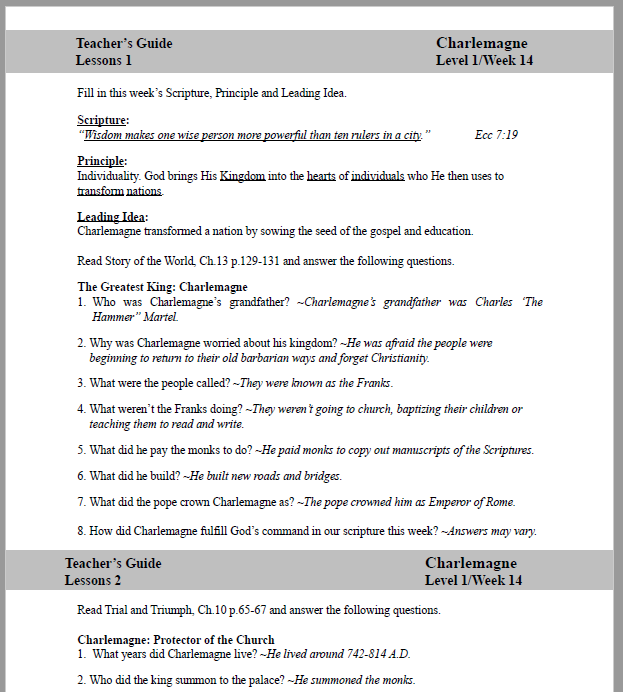
As I have mentioned, along with the Student Guide, we received the Teacher's Guides for both Levels 1 and 2. The overview and weekly grid information are the same as are found in the Student Guides. I have to say, the instructions and answer key information are extremely helpful, especially ensure that we have the answers that the curriculum is looking for. 

Here is a look at the answer key information for the page about Charlemagne that I shared above:

Level 1


Level 2


I admit, I wish there were answers for the tables we are supposed to be filling out while reading The Magna Charta by James Daugherty, because we are all having trouble locating the information we are supposed to be filling in. 

As I mentioned toward the beginning of this review, I also received the PDF download for both The Chain of Liberty written by Jayme MacCullough and the Study Guide that goes along with it. I was pleasantly surprised when I saw the email with the links honestly, seeing as this book is used with Level 3 and Level 4, so I didn't think we were supposed to get it. So, while I will not be using it with the children, I hope to find some time to sit down and read it thoroughly myself, perhaps during the summer when I don't have so many other obligations. 

I did want to share a bit about the book. 

After the Introduction, there are two sections to this book. 
  • Language, Principles & Links Pertaining to Liberty
  • The Chain of Liberty
The Chain of Liberty stretches way back to the beginning of time:
  • Creation Link
  • Dawn of Nations Link
  • Moses and the Law Link
  • Church Link
  • Reformation Link
  • First Colonies Link
  • First Constitutional Republic Link
  • Expansion and Erosion Link
  • Restoration Link
This book shows how the links in this chain are connected when it comes to the people, ideas, and events. 

I do wonder if we missed something by skipping ahead in the curriculum to the middle of the Middle Ages. Perhaps, if we had started this curriculum from the beginning of Year 1: Universal History, we would have a clearer view of the way the links all fit together. 

All-in-all, I do like the way this curriculum is arranged. It is so important that children have a clear view of God's hand in history. I love that Pathway to Liberty has a Biblical worldview. I appreciate that we are able to dig deep into the people and events we are learning about, instead of just reading a bit about them and moving on. That said, I am a bit ambivalent when it comes to how I feel about the curriculum. While we spend a week on one person at a time, we then have to sacrifice learning about others who may have also made an impact during these timeframes. I completely understand that there is only so much information you can learn and while one curriculum may teach more in quantity, others may have fewer people and events learned about while going into more detail. 

The children actually did enjoy Pathway to Liberty, though they felt it had a bit more work than they are used to. They were also frustrated when we couldn't figure out the answers to the questions, and Amelia stated she really didn't like having to do the word studies as they were just "too difficult." I know Harold was not fond of having to answer all the questions and would get frustrated. I would say, even though Level 1 is recommended for children in K5 through 3rd grade, it may not be suitable for some kindergartners or first graders. I have mentioned during these past few weeks, to the children and my husband, if I can't figure out the answer to some of these questions, I can't really expect the children to be able to figure them out.

So, while I do feel Pathway to Liberty is a great curriculum, we are returning to the familiarity of our core curriculum. Sadly, Pathway to Liberty just isn't quite the right fit for our family. 

You can find Pathway to Liberty on Facebook, Twitter, Pinterest, YouTube, and Instagram.

Don't forget to click on the banner below to see what my fellow Crew Mates had to say about the different Levels and Years of Pathway to Liberty that they reviewed. 

Universal History,  The Middle Ages,  US History & World History Curriculum {Pathway to Liberty Homeschool Curriculum Reviews}
Crew Disclaimer

Tuesday, August 21, 2018

Littles Learning Link Up: 5 Days of Homeschool Encouragement: Take a Look Tuesday


 Each month you will find:
  • A seasonal round-up (usually toward the beginning of the month)
  • Posts where I share what I have been up to with my early elementary children (including occasional highlight posts where I share how we used ideas that have been linked up here on Littles Learning Link Up).
Each week, I will host a link up, where you can share either what you have been up to recently, or old posts that may go with the theme.  Feel free to link up more than one post.

Each week I will continue to feature a couple of posts from those that have been linked up. 

I hope you will continue to share your wonderful posts, and I hope you will find something new to try with your child(ren).

It would be great for everyone to stop by and visit the other linked-up posts as well. Check them out, leave some comments, pin those that interest you. Let's make this a real party and socialize with each other.

What have we been up to?

We are, once again taking a bit of a break, though the children are still working on their few review products online. Plus we have some books to read. Both Summer Reading Programs are finished. VBS is over; what a wonderful few days we had! We will have two weeks to relax and get organized for the new school year, which starts September 3rd.

I know there are some who have already started back up with school, and some who will start later in September, but I have a feeling there are many who are in "Back to Homeschool" mode, especially with all those "Back to School" sales floating around. Well, in case you didn't know, I am participating in this year's Homeschool Review Crew 5 Days of Homeschool Encouragement. Yesterday was Motivation Monday. Today is Take a Look Tuesday, which I decided to combine with Littles Learning Link Up.

Sooo, let's Take a Look:


Take a Look Tuesday

Welcome to the 5 Days of Homeschool Encouragement Back to School Blog Hop from the Homeschool Review Crew. I am so glad you are here. My fellow Crew Mates and I are hoping you will find encouragement through these posts this week.


Today I decided that we would take a look at our 2018-2019 Homeschool Curriculum.

We will continue to use My Father's World as our Core Curriculum. This year we will be using Rome to the Reformation, continuing our study of history from where we left off in Ancient Greece from last year.

Here are all the books/materials that come with the Deluxe edition of Rome to the Reformation.


The children enjoyed finally being able to "take a look" at our curriculum. We've had it since March, but I only glanced through the box before we had to hurry off somewhere, and I packed it all away without us really looking at it.


Additionally, we needed to keep the following books from last year:


Ancient World, Streams of Civilization: Volume One, and Journey through the Bible are part of the history component that spans Creation to the Greeks and Rome to the Reformation. 

History from our RtR shipment:


We've got The Roman Empire, Augustus Caesar's World, Galen and the Gateway to Medicine, The Story of the World, Medieval World, Trial and Triumph, plus the Make a Castle activity, Starting Chess, and How the Bible Came to Us.

To help enhance our history portion, we will also be reading these living books:


Dangerous Journey (The Story of Pilgrim's Progress), The Bronze Bow, The Door in the Wall, and Twice Freed.

For science we will be looking at the Human Body the first half of the year, and then we will move into Astronomy.


We'll be using Exploring Creation with Astronomy from Apologia (which we started a while ago as a review, but when I realized we would be using it this year, we set it aside). And for our Human Body portion we will use the First Encyclopedia of the Human Body, The Body Book, The Wonderful Way Babies are Made, The Human Body for Every Kid, and I'm also sticking Galen and the Gateway to Medicine with our Science books. I also plan on using some Answers in Genesis DVD's our church has.

Moving on to English/Language Arts

One other component that continues with us from Creation to the Greeks is our vocabulary book, English from the Roots Up. Last year we focused on the Greek roots, this year we will learn the Latin roots.


Of course, we are also learning Latin with PictaDicta from Roman Roads Media, a current review product. And I will be pulling out Tabitha's Latina Christiana from Memoria Press which we reviewed last year (and set aside in anticipation of this RtR year).


Here is what we will be using for Spelling:

Tabitha and Amelia will continue using Phonetic Zoo from IEW.


And Hannah will continue to use Traditional Spelling from Memoria Press.


I'm not sure if I will worry about spelling for Harold yet or not.

For the remainder of Language Arts, the older girls will continue to use Grammar Planet, which we are currently reviewing.


Hannah will continue on with Grammar and Writing 3 from Hake/Saxon, which we reviewed at the end of the school year.


Plus I may have her continue working in Eclectic Foundations Language Arts B.


Harold will continue to use Grammar Galaxy.


Harold is also using Reading Eggs/Reading Eggspress currently for review purposes.


And we will pick back up with our neglected Poetry Memorization from IEW. I completely forgot about it last year.


For math the children will continue using CTCMath.


Though Harold will be using MathSeeds until our review subscription expires.


My Father's World also has a music component. We will continue our study of classical music with the following three composers: Haydn, Beethoven, and Mozart.


Here is what we will be using for art, also from My Father's World. Hopefully we will fit it in better this year than we did last year.


We will also continue using The Master and His Apprentices for Art Appreciation.


And that is what our 2018-2019 year looks like. For now. As you know, because we are on the Homeschool Review Crew, our curriculum changes up a bit at times through the year, though we always stick with our core.

Here are some of the other participants in this week's blog hop, and you will find more in the linky below.

Marla @ Jump Into Genius 

The following linky is for the 5 Days of Homeschool Encouragement blog hop! To link up to Littles Learning Link Up, please go to the end of the post as usual.


Back to our regularly scheduled Littles Learning Link Up!

Let's take a look at that review schedule real quick:

Last week I shared my review for the Paddington Lit Study from Branch Out World. Next week you will find my review for GrammarPlanet. In September (which I can't believe is so close) I will share my review of PictaDicta from Roman Roads Media, Reading Eggs (both the new Reading Skills for First Grade workbook and the Reading Eggs/MathSeeds website), and two Kingdom Files books from Barbour Publishing.

Now onto:
Littles Learning Link Up Features

On my last Littles Learning Link Up post, there were 4 wonderful posts linked up. I will be sharing  the two most clicked on posts. 

Please, don't forget to stop by other posts that are linked up. See what catches your eye, stop by, pin the post to a relevant board, and perhaps leave a comment to let the author of the blog know you have been by for a visit. I know I appreciate others commenting and letting me know they have read my posts, so I am sure others do too.

This week's first featured post is:


Brandy from The Barefoot Mom shared Math Outside the Classroom.

This week's second featured post is:


Thaleia from Something 2 Offer shared Crafts for Back to School.

Join the Party!

I would love to have you join in this week! What sort of activities do you do with your young children? Do you have some favorite activities you would like to share? I invite you to link up below. I will be pinning posts on one of my relevant boards, and I would love to feature some of the activities each week from what is linked up.

Please know I may share a picture from your post and link back to it, along with sharing how we used your idea in our school time. By linking up you are giving me permission to use a picture from your post. I will ALWAYS give credit and link back. Additionally, if you choose to try out any of the ideas with your child, please make sure you give credit where credit is due.

Linky will be open through Monday night, to give me time to check out all the posts and get the Features organized. Please take the time to visit some of the other wonderful posts linked up.

No button currently, and there won't be one until I can figure it out seeing as Photobucket has changed things. Feel free to still share the picture in place of the button. Just link it to my Littles Learning Link Up permalink please.


I am sharing over at

Homeschool Coffee Break


Related Posts with Thumbnails