Showing posts with label spanish. Show all posts

Friday, October 25, 2019

Immersing Ourselves in Spanish with Excelerate SPANISH {A Homeschool Review Crew Review}

One of the subjects that I haven't been consistent in teaching to the children is foreign language. Ever since working at the Montessori years ago, and seeing how well younger children do in learning a foreign language, I knew I wanted to be able to teach them when they were younger, instead of waiting until junior high age, which is how it was for me (and I believe how it typically is). We've worked on it a little here and there; however, with our very busy schedules, foreign language instruction usually falls by the wayside. When the opportunity came up through the Homeschool Review Crew to try out the Excelerate SPANISH Streaming program from Excelerate SPANISH, I thought it would be neat to give it a shot. 


We received a one year subscription to this immersion type program which also includes Total Physical Response (TPR) teaching. There are a total of 48 lessons (24 in Spanish 1 and 24 is Spanish 2). These lessons range in length from 30 minutes to around an hour. Once we were signed up, it was simple to log into the site. 


We "join in" with the class of children who are being instructed by the teacher, Caryn Hommel. Caryn just happens to be a homeschool mom herself, and she has taught ESL for years. Now, let me just clarify, though these are called "streaming videos," we are not joining in with the class live. We are watching the recorded lessons.

As we sit at our computer as students in this "class," we watch as Mrs. Hommel teaches us a LOT of new vocabulary. She shares several words or phrases at a time, writing them on the whiteboard, along with the English translation. She does say the words/phrases out loud so we can hear how they are pronounced.


After she is done writing, she puts her book down and goes down the list, one word/phrase at a time, giving us a motion to go along with it. Sometimes there is a picture or an object to point to instead.


She then asks the children to "show her" a combination of the motions. She asks for them in Spanish. This helps children connect the Spanish word and the motion, to give less emphasis on the English word, so they aren't translating it. Just learning it as they would their native language. You know, like when a baby learns a language, they learn what an object is by connecting it to the word they are hearing. Granted, once children are older, they already know what the English word is, so I'm sure there is a part of their brain that is connecting to the English word as well. I know that is what happens when I try to learn this way, plus when Harold wanted to show me some words, he was showing me the motions, but using the English words because he couldn't remember the Spanish words. 

Here are Harold and Hannah demonstrating the motions for some of the words in the "Going Fishing" lesson. The camera angle switched between the teacher. . .


. . . and the students. 


The words they are learning here are afilados (sharp), los ganchos (hooks), and cuidado (careful).


After she goes over the short list she has written out, she adds more to the board, following the same pattern. Of course, as she goes along, she has more and more words and phrases that she can combine for the children to show her. 

 Then she begins to tell a story with these phrases and she will ask for a student to volunteer showing the words while she says them. 


She then asks everyone to join in with the motions.


And then they actually act out the story from beginning to end. She has read the entire story to us in English, so we know what is going on, then she does it in Spanish.

In the screenshot below, the boy is playing "Roberto" and the girl is playing "Anna." They have been waiting for a bus and a taxi comes along. Anna was going to get in the taxi, but Roberto runs faster and gets in the taxi first. 


Then at the end of the lesson, she reads the story again while everyone does the motions. This is repeated again. And then at the end the Mrs. Hommel makes the motions and asks the students to tell her the story in Spanish. So, the story is repeated multiple times in an attempt to learn it. 

There is also a section in the middle of the lesson, and one at the end, where the children on the video pull out their workbooks to review the material learned. We did not have access to these books as a part of this review. So, we can only listen while they go over it. We try to understand what Mrs. Hommel is saying, but it was quite difficult. I do wish the workbooks had been a part of the review. It was said that the books were optional, but it sure would have been easier to follow along. 

The other problem we had, is that, when the teacher was speaking to us fully in Spanish, she was using words we hadn't learned yet. This, of course made it even more difficult to follow along. I do understand that that is a part of the immersion method of learning, but it is very frustrating to me, and as I have learned, it is frustrating to my children as well.

Due to the fact that we are having trouble with understanding and retention, we have been moving very slowly through the program. We definitely need multiple viewings of the video lesson to be able to understand. And, because the lessons are on the long side, we've been breaking them up and watching them on different days. So, we are still only on lesson 2: Going Fishing. Being able to go to the Quizlet site and practice the vocabulary is quite helpful.

Even though we are only on lesson 2, and we know it is going to take us a while to make it through Spanish 1, I did want to share a little bit about Spanish 2.

From what I could tell, it has more of a classroom feel to it, because they seem to be in a real classroom, as opposed to the room which appears to have been in Mrs. Hommel's house from Spanish 1. I'm not sure if she gets into grammar in Spanish 1 toward the end, but it definitely is present immediately in Spanish 2. She seems to follow the same teaching method, of teaching words and phrases and having the children do motions, but when they tell the story, they have costumes. And there are even graphics included in the video. 

Things I love about this program:

I love that it is interactive. The children use motions to join right in with the students on the video. The inclusion of Total Physical Response (TPR) teaching is a wonderful way to help children memorize things. We have used motions or sign language since the children were toddlers while memorizing our Bible verses. That added movement really does help make connections in the brain. Honestly, it was what drew me to this program. I was like, "Hey, that's how I like to teach."

I love that we get to hear the Spanish words being spoken. I mean, sure we can see them written out in a book or workbook, but being able to watch a video of the words being spoken, while seeing them written as well, is wonderful. 

We are using quite a few of our senses and types of learning styles while using this program. Movement, hearing, and seeing (both the motions and the words).

I love that the words and phrases join together to tell a memorable story.

I love the repetition. And because we are viewing these, we can watch them again and again, repeating the information even more. 

Things I wasn't quite as fond of:

I mentioned that I loved the stories; however I did question the relevance of a story of waiting for the bus and running for the taxi, especially because we live in a rural area, which means we never wait for buses or take taxis. I'm not saying it wasn't a great story with great vocabulary learned. I was just curious as to why Mrs. Hommel decided to start with a less relevant story for children, when later on in the program she has some really cool sounding lessons that would capture children's attention a lot more (such as A Video Game, and A Little Ice Cream). 

I was not a fan of the fact that the one character yells, "Stupid!" to the other character after he "steals" the taxi out from under her (so to speak). Definitely not a fan of that word. I was a little surprised the teacher was teaching children to yell that at others. 

While I understand that this is an immersive program, there were times we just couldn't keep up with the teacher to understand what she was asking the children to "show her." When she was speaking completely in Spanish, I wish she was just a little slower for those of us who struggle with foreign languages. 

All in all, I do like this program. However, it wasn't well liked by my children. Unfortunately. I had to force them to watch, and they had trouble following along and understanding. I do feel having the workbooks would have been beneficial and helped us along. Though I was very thankful for the link to the Quizlet site where we were able to review the vocabulary with online flashcards. There is also a section where you can hear the words being spoken.

You can find Excelerate SPANISH and Caryn Hommel on Facebook, Twitter, and Pinterest

Don't forget to click on the banner below to see what my fellow Crew Mates had to say about Excelerate SPANISH.

Excelerate SPANISH help your students to learn FAST, naturally! (Streaming)  {Excelerate SPANISH Reviews}
\
Crew Disclaimer

Monday, June 12, 2017

Immersing Ourselves in Spanish with Whistlefritz {A TOS Review}


I have mentioned before that I feel it is important for children to start learning foreign languages at an early age. Ever since Tabitha was a preschooler, I have found ways to include some instruction in foreign language, usually Spanish, but sometimes French as well. I don't remember all the details about the research behind learning a foreign language at a young age, but I do know they are a lot more receptive, and their brains are at the point where they can just soak up this information. I also remember how well the children did when learning French and Spanish when I was working with the preschoolers in the Montessori. Lately however, most of the foreign language programs we have been learning with have focused more on the older girls. Which means Harold and Hannah have been missing out. That is why I was thrilled when we had the opportunity to review the Educator's Spanish Collection from Whistlefritz.


Whistlefritz is an immersion foreign language program that is designed for young children, anywhere from ages 1-7 years old. The Educator's Collection that we received contains all of the Whistlefritz Spanish DVDs and CDs. Plus we received the Spanish Matching Card game and the Spanish Lesson Plans For Kids. 


There are five DVDs and three CDs included in this boxed collection.


Here is a list of the DVDs:
  • Los animales
  • Vamos a jugar
  • Adentro y afuera
  • Las estaciones
  • La fiesta de fritzi
And here is a list of the CDs:
  • ¡Sabor!
  • ¡A Bailar!
  • Cha, cha, cha
The earlier DVDs, Los animales and Vamos a jugar, are recommended for younger ages, 1-5, while the remaining DVDs are recommended for slightly older children, ages 2-7. My children have been enjoying each of the DVDs we have watched so far, and they range in age from 5-10.


The Lesson Plan book is full of fun hands-on lessons. It is designed for preschool through early elementary aged children. The book begins by telling us a little bit about the authors and some information about Spanish vocabulary. After the Table of Contents and a Foreword, we move straight into the Lesson Plans. There are 40 activity-based lessons, which also bring in other subjects, such as math and science, making this a great cross-curricular program. We start out by learning how to introduce ourselves (greeting, name, how we are). Then there are lessons that focus on colors, numbers & counting, shapes, and places to live. There are also lessons on family members, clothing, seasons, parts of the body, food & drink, and animals. Each of these different topics has multiple lessons that build upon the previous lessons. 

Each lesson follows the same basic format. At the top of the page you will find a brief description of the lesson, the goal, the objective, the list of vocabulary learned in the lesson, materials needed, and time required to complete the lesson. Then the activities are fleshed out with the focus, scripted teacher input (in English and Spanish), guided practice, independent practice, closure, and extension activities. 

These lesson plan instructions are usually printed on two pages, though sometimes the lessons are short enough that all the information fits on one page. The majority of the lessons have reproducible pages for use during the lesson. 


Lesson 3 required the following pages for the Presents Game:


The present cards were to be cut out and colored. The number cards just needed to be cut out (there was also a number 10 card on the next page). And there were several game boards so each child could have a different one.

The reproducibles vary from lesson to lesson. There are game cards, game boards, graphs, templates, flashcards, worksheets, pages & images for making books, paper dolls, and more. Some lessons have very little parent/teacher prep time, while others are definitely more time intensive when it comes to getting the materials prepared. Most of these materials are usable in their black and white format; however, some need to be colored. If you don't mind using colored ink, some of these can be found on their website in color, making for less work for the parent. Though, coloring the pieces can be made to be a part of the lesson, and the children can become even more involved.

The Spanish Matching Cards Game is for ages 3 and up.


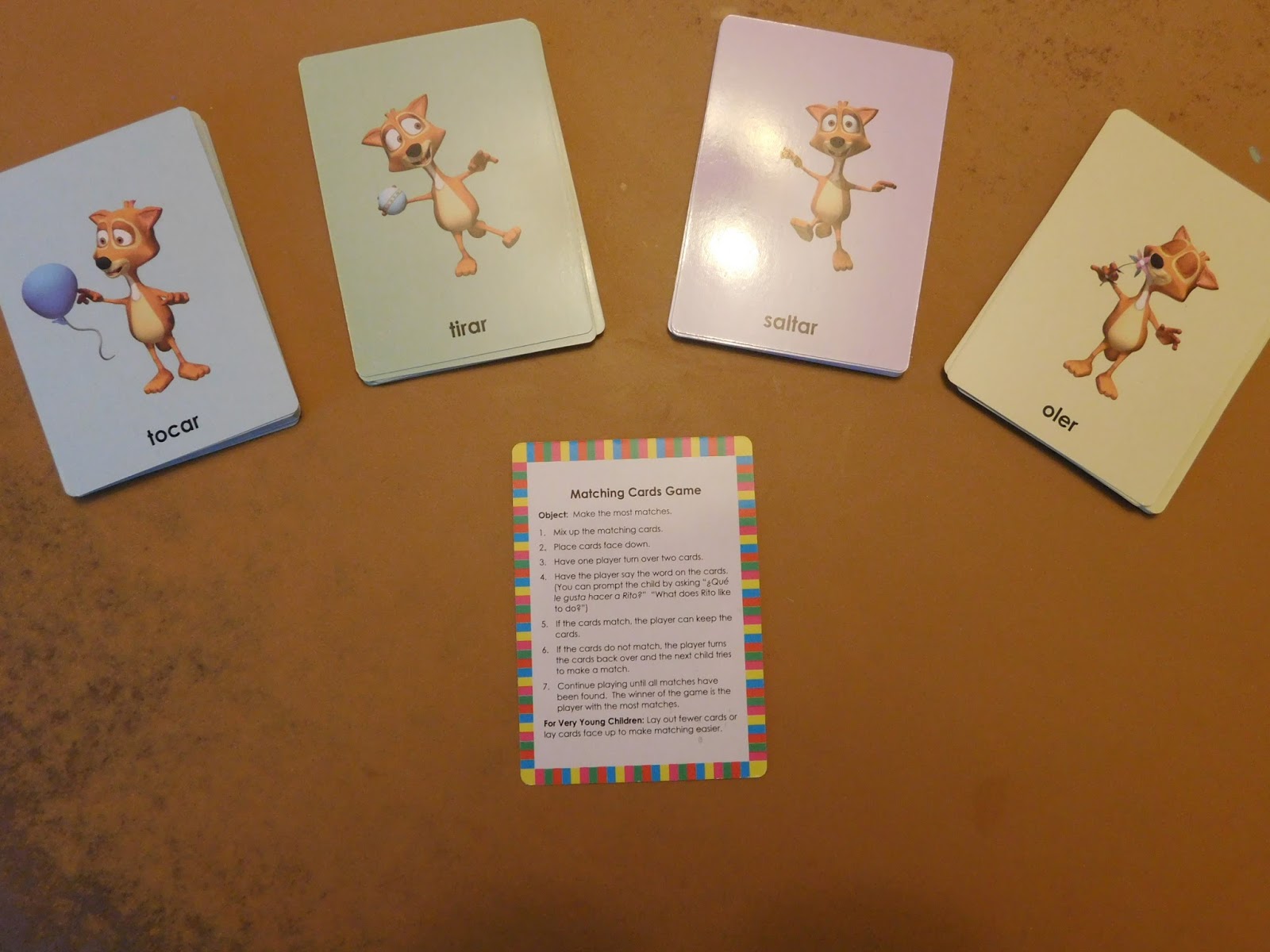
It contains 50 colorful cards that feature Rito the fox, plus an instruction card (English on one side, Spanish on the other). As it is a memory matching game, there are two of each card. All of the cards focus on different actions that Rito is pictured doing, along with the Spanish word at the bottom of the card. As you can see, the background of the cards are different colors. There are blue, green, pink, and yellow backgrounds. However, I haven't really been able to determine if there is any reason for the different actions to be on the specific colors, and they are not divided evenly into the different colors. There are 8 pairs of blue cards, 5 pairs of green cards, but 6 pairs of both the pink and yellow cards. Luckily I'm not OCD like my husband, because I am sure that would drive him crazy. This isn't really anything negative about the cards and doesn't affect game play, but it did make me curious.


I have found that some of the actions are easy to figure out the meaning for, while others may need some help of some sort of translation site online or an English/Spanish dictionary (do people still use those?).

Now that I have shown you everything we received, let me tell you how we used this Educator's Spanish Collection of Whistlefritz. 

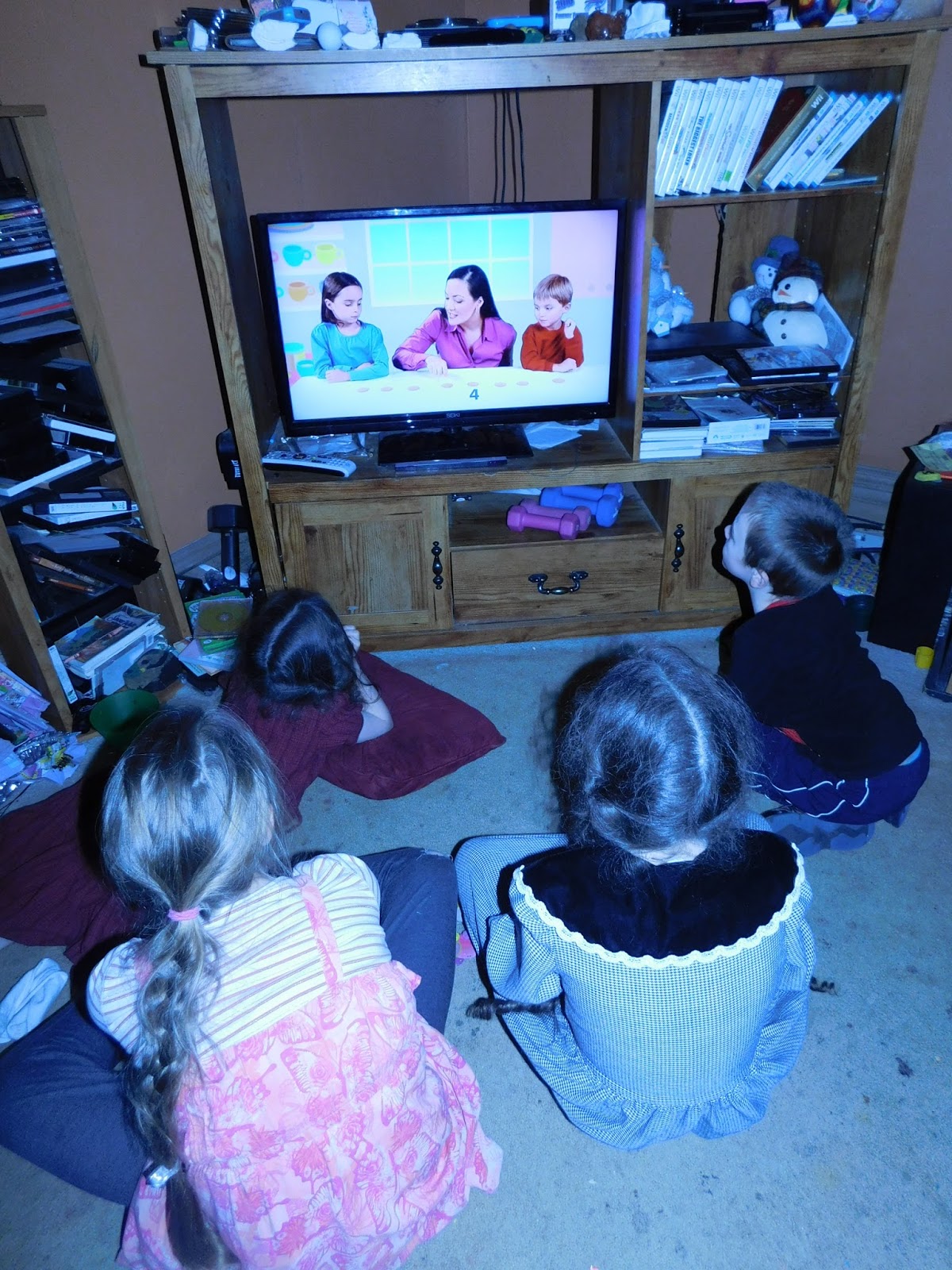
It is recommended to introduce the child(ren) to the program by showing one of the DVDs. Though Harold and Hannah are the primary children using the program, all of the children enjoy watching the videos. 


Yes, that would be the box the program arrived in right there next to Harold. They were quite excited to get it out and start watching.

The videos are a combination of live action and animation. Sometimes we may see children playing or interacting with family and friends.


Sometimes we will see Maria interacting with children.


And other times she is interacting with Fritzi the animated mouse, or even different puppets.


And there are also the fun song segments, which sometimes have this gentlemen playing his guitar:


As this is an immersion program, the characters speak and sing only in Spanish. There is no translation in the videos whatsoever. They do not translate verbally and there is no English translation on the screen. However, Maria and the children will repeat words or phrases over and over again, demonstrating what they are talking about. She will ask questions, expecting a response from the children. Then Maria will elaborate in a sentence, repeating the word with more detail. As the viewer watches the children on the video respond, they learn how to respond as well. 

The videos are only scheduled in the lesson plans in segments. So, when we did lesson 1 for example, which focused on greetings, we watched "Buenos dias, amiguitos" on the DVD Vamos a jugar. We also listened to it on the CD ¡Sabor! out in the van when we didn't have electricity. When we were learning about colors while preparing for Fritzi's birthday party in lesson 2, we watched the scene from La fiesta de Fritzi where Rito the fox catched different colored balloons.


And while we were learning numbers and one-to-one correspondence in lesson 3, we watched the song "Los deditos" on Vamos a jugar

I admit, we usually end up watching more than just the one scheduled song, because the children really enjoy watching these videos and don't want to stop with just one short segment. Also, not all lessons have a recommended video segment scheduled, but when one is listed, it will be under the "Extension Activities." So, there are days I just pick, or have the children pick which video they want to watch for their Spanish time.

After we watched our first video all the way through, I started following the lesson plans. We have averaged about two lessons a week, but, as I mentioned above, we have also been watching videos and listening to the CDs at other times during the week. I follow the scripted lesson as well as I can. The sentences are given in English and then in Spanish in the parentheses. I tend to choose parts of the Spanish to say, as I can't always pronounce the words. When I stumble over the Spanish too much, the children are lost. I do try to use as much Spanish as possible, and I use motions to try to get them to understand what I am saying.

We start each lesson with a lot of review from the previous lessons.

Let's look at the hands-on aspect of this program. 

We made puppets to use while learning about greetings:


Then we used paint to mix colors and make balloons for Fritzi's birthday party. We were supposed to use transparencies and markers to create balloons to mix colors, but as we didn't have those, I decided we would have some color-mixing painting fun with the extension activity as our main activity. 


We would say the colors in Spanish and then I would ask (in Spanish) what color we get when we mix each color.


And it gave us balloons to use when we reviewed colors. I use these balloons to have the children tell me the color (¿Que color es este?), and find the color (¿Donde esta el globo rojo?).


We learned the numbers in Spanish and worked on one-to-one correspondence with the Birthday Present Game. Even Amelia joined in on the fun!


We continued our study of numbers and colors, while adding in sorting and graphing. Yes, Amelia really has been enjoying Whistlefritz along with the younger children.


We learned about shapes while reviewing our colors with these flashcards.


We learned how to say "This is a color shape"

For example:

"Este es un triángulo amarillo."

Then I cut out a bunch of shapes using the provided shape templates, so the children could each make a collage.


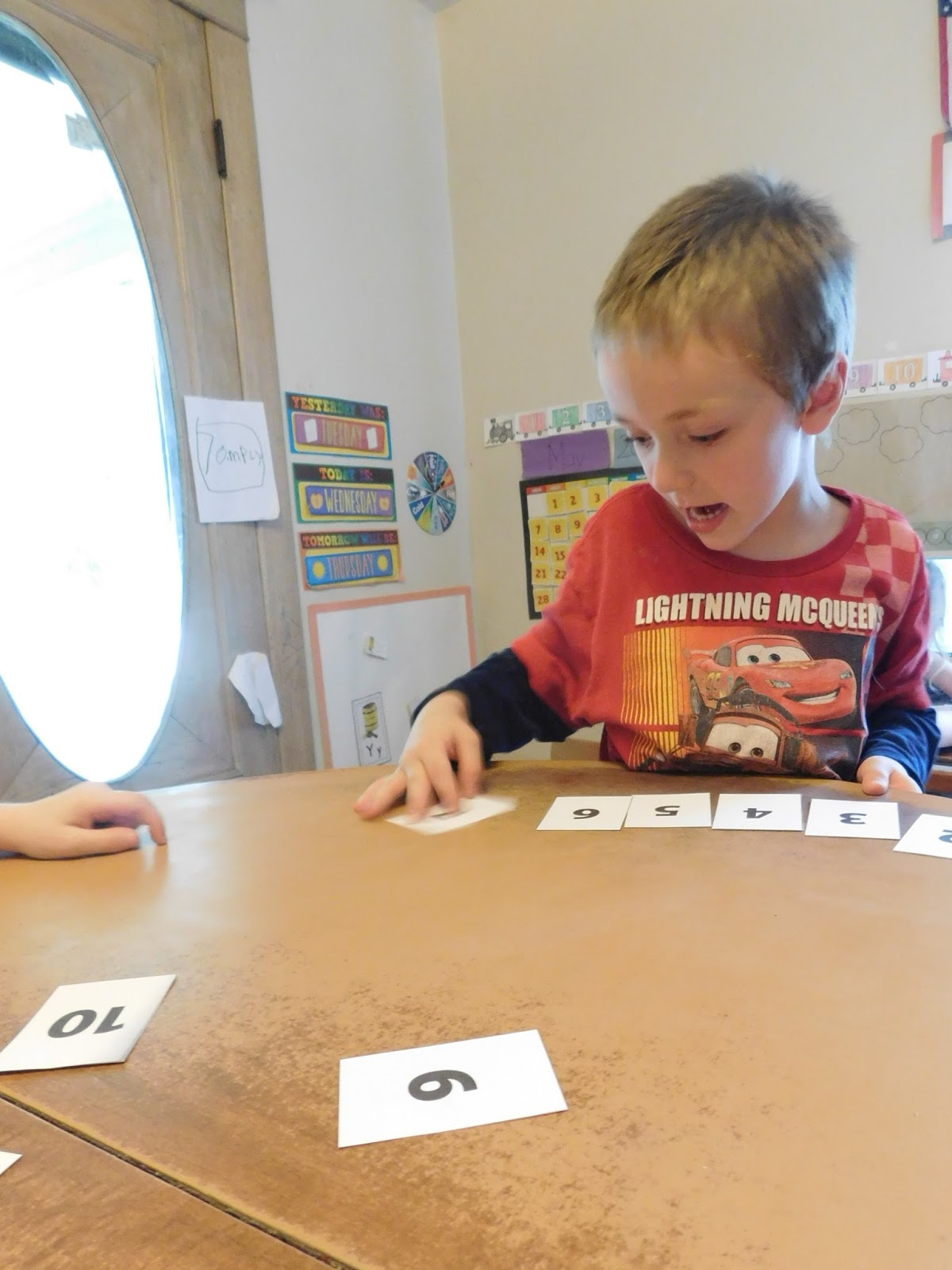
As Harold has been struggling with remembering the numbers in Spanish, we have spent some time reviewing numbers. I had them lay them out, count them, and identify them.


We recently moved on to learning about where we live (in a house, in a town) and will be moving on to different parts of the house next.

And yes, we reviewed colors once again with this worksheet.


Whistlefritz is a wonderful foreign language program for young children. I love the inclusion of different subjects with the cross-curricular content in the Lesson Plans. And the hands-on activities are great, though sometimes they get postponed when I discover I have lots of preparing to do. As I was getting ready for the graphing with goldfish crackers lesson, I remember wishing there was a list at the beginning of the book which told the parent/teacher what materials were going to be needed for each lesson. Granted, better organization on my part would also have helped. There is a lot of photocopying necessary for preparing the lessons. Personally, I would prefer the black & white reproducibles be available online along with the color versions. This is mainly because my printer uses a lot more ink in copy mode. 

The videos are so cute and fun to watch. Even mommy has enjoyed watching them in an attempt to improve her Spanish. The younger children have admitted they still are unsure of what is being said a lot of the time, even after multiple viewings; however, the older girls are definitely catching on. It is recommended not to translate into English, but all the children do attempt to do so. I think the younger a child is introduced to these videos, the more likely they will not need the English translations, but I am not positive about that. Still, they enjoy watching them and I think they are getting more out of them than they are realizing.

We enjoy listening to the CDs in the van, though I admit, we really have no idea what is being said in most songs. I have been able to figure out some obvious ones, like "Old MacDonald had a Farm" and "Head and Shoulders, Knees and Toes," and we are learning more as we continue to listen. The back of the cases for the DVDs and CDs state that translation guides are inside; however, they are actually found on the website, and I only just figured out where they are. You can find these word-for-word translations for the CDs on the Translation Guides page. We will definitely be using these going forward. There are translation guides for the DVDs as well, though they don't have the word-for-word translations for the songs. However, it appears that they do have translations for all the words taught on the DVD.

This is definitely a foreign language program suitable for younger children, and it is one that I highly recommend. 

You can find Whistlefritz on Facebook, Twitter, and YouTube.

Don't forget to click on the banner to see what my fellow Crew Mates had to say about Whistlefritz. Some reviewed the Educator's Spanish Collection like we did, while others reviewed the Educator's French Collection.


Spanish and French {Whistlefritz Reviews}
Crew Disclaimer

Sunday, May 15, 2011

School Time Week 32: K is for Kisses and Kittens

This week we started and concluded our letter K.  We will be continuing our /k/ sound next week with the letter C.
We started, as usual, with our K muffin tin:


I found a cute version of Three Little Kittens at the library where we go to story time.  The librarian had actually read this book several weeks ago.  This version is written by Jerry Pinkney.  
Three Little Kittens
The illustrations were beautiful and the story is cute.  Though I have to warn you, the story is told quite a bit differently.  I then found a free lapbook activity over at Homeschool Share.  The girls needed to color and cut out some mittens. 


Then I hid them around the living room.  Amelia then took a turn hiding them from me.  I did decide to just use these as activities instead of a lapbook.  Mostly because I don't have any file folders left.  We didn't do any more of these activities until later in the week.

Then I came up with a little tracing/gluing activity:

They were to glue the K on and trace the words.


Amelia's tracing is still improving.

Even Hannah wanted to write.


Then the girls really got to kiss the paper.


Tabitha wanted to give her's a happy face.

Amelia's is sad because it is bleeding.  Or as she says, "It has bleed."

We don't usually wear makeup, but I made an exception for this.  In fact, we had to go out and buy the lipstick because I don't have any in the house.

Then Hannah had to see what was so fun about sticking faces on the paper.


Yummy!


 Today we again worked on the Three Little Kittens.  The girls cut apart the pages and glued the little pictures that I had printed out from Homeschool Share.  This version was closer to the traditional Three Little Kittens. Though the last line of each verse was changed.  For example, I know the last line of the first verse to be like this:
"Our mittens we have lost."
Their version reads, 
"That we have lost our mittens."
It just didn't sound right to me.
Anyway, because we put together the books I decided to ask the girls if they wanted to make pie.  So we made a nice simple chocolate peanut butter pudding pie. I follow the instructions on the box of instant chocolate pudding.  Except I usually double the recipe, add a 1/4 more milk and add 3-4 heaping tablespoons of peanut butter.  Then I add chopped up Reeses Peanut Butter Cups.  The girls took their turn cutting them.


And adding the pudding mix.


Then they added the chopped up candy when I was done mixing it.

I told the girls they could eat the pie for dessert at dinnertime while wearing some mittens.


 Yes, they soiled their mittens.


We have been enjoying some fun outdoor time at the park again this week.


Hannah just loves the slide.

Today when we went over to the park I started teaching the girls some Spanish using  a book I found yesterday at the library.  I have wanted to teach the girls a foreign language for some time.  I let them watch Dora the Explorer, but there isn't as much Spanish in there as I had originally hoped there would be.  A while back I had taken out Muzzy from the library, but I didn't really care for it.  The other day I saw a program mentioned/reviewed over at Weird, Unsocialized Homeschoolers called Speekee.  You can choose DVDs or the online version.  With the online version you can receive 2 weeks of a free trial before deciding if you want to pay the $7.50 per month.  I have not yet had a chance to check it out, but I am looking forward to it.  I want to make sure we will have the chance to really take advantage of the free trial.  It looks really good.  Filmed in Spain with Spanish children speaking only Spanish.  It has English and Spanish subtitles.  I love the idea of the immersion method for teaching a language.  So, if you are interested in teaching your children a foreign language you can also head over here to take advantage of the free trial.  As I mentioned I have not tried it yet.  You can head to Weird, Unsocialized Homeschoolers for her review.

Anyway, back to the book I found at the library.  It is Play and Learn Spanish by Ana Lomba and Marcela Summerville.
Play and Learn Spanish (Book + Audio CD): Over 50 Fun songs, games and everdyday activities to get started in Spanish (Play and Learn Language)
The authors are natives of Spain and Argentina respectively but now live in America.  In this book they share songs and dialogues for different scenarios, such as Time to Get Up!, Time to Get Dressed!, Let's Go To The Park!, and Let's Go to Bed!
The Spanish version is written side by side with the English and there are key words highlighted in addition to several pictures on the bottom of the page that are also highlighted.  This also comes with a CD.  I took it to the park and started using some phrases with the girls.
Vamos al parque-Let's go to the park.
Hemos llegado al parque- We have arrived at the park (wasn't that far of a journey, just across our back yard)
Qrieres ir al tobogan? Would you like to go on the slide?
and lots more.  
I am still not sure of my pronunciation, but I repeated the phrases over and over again.

Not sure how things will go, but I will be mentioning it again after having some time to really use it.

Please take a moment and check out my giveaway for Chicken Soup for the Soul: Shaping the New You.  I am keeping it open til June 1st.


I am linking to:


Tot School


Shibley Smiles


link-up-friday-buttom_thumb
Share It Friday


The Attached Mama’s Ultimate Alphabet Craft Collection


I found a great new linky to link up with
Classified: Mom
Also linking to:


Related Posts with Thumbnails