Showing posts with label writing. Show all posts

Thursday, August 20, 2020

Improving Writing Skills with Structure and Style for Students {A Homeschool Review Crew Review}

Disclaimer: I received a FREE copy of this product through the HOMESCHOOL REVIEW CREW in exchange for my honest review. I was not required to write a positive review nor was I compensated in any other way.


One of the subjects I haven't been focusing on very well in our homeschool has been teaching the children to write. Not handwriting, but the mechanics of proper writing. Let me tell you a little secret. This is a subject I am not the greatest in myself, so I am not quite sure how to properly teach the children. So, I was thrilled when we were given the opportunity for the younger children to try out Structure and Style® for Students Year 1 Level A from the Institute for Excellence in Writing®. This is a company we have come to know and love. The children recognized Mr. Pudewa's voice from when we reviewed Developing Linguistic Skills Through Poetry Memorization several years ago. Plus the older girls had used Phonetic Zoo for their spelling.


IEW®'s Structure and Style® for Students curriculum is available at three different levels. Level A is for children reading at a 3rd-5th grade level, Level B is for children reading at a 6th-8th grade level, and Level C is for children reading at a 9th grade level or higher. Currently only Year 1 is available; however, Year 2 is expected to be released next spring. 


The Structure and Style curriculum for each of the levels is 24 weeks in length. It's composed of both physical and digital components. We received both the Teacher's Manual and the Student Binder in the mail, and we were given access to the online "Forever Streaming" video lessons via an activation code on the instruction card that came in the binder. These lessons are available to us as long as we need them and can be used by multiple children. We are also allowed to photocopy the student materials for use within our family. 

This writing curriculum focuses on the following skills in seven units:
  • Unit 1: Note Making and Outlines
  • Unit 2: Writing From Notes
  • Unit 3: Retelling Narrative Stories
  • Unit 4: Summarizing a Reference
  • Unit 5: Writing From Pictures
  • Unit 6: Summarizing Multiple References
  • Unit 7: Inventive Writing
A Scope and Sequence tells us what reading passage we will be reading in each lesson in the units, the "style" we will be working on, if any (not every lesson has a new style to learn), plus literature suggestions. 


There are daily lessons laid out in a chart that is available in both the teacher manual and the student's sheets. There are even suggestions on how to adapt the schedule for homeschool versus classroom setting and different weekly schedules. Both the videos and the physical portion are necessary for the program. Each week the students will view the lesson with Mr. Pudewa teaching, during which he will tell them to get out specific sheets for that section of the lesson. 

Mr. Pudewa is teaching a group of students in a classroom setting, utilizing both the student sheets and a whiteboard. As viewers we can listen to his and the children's answers and then pause the video and discuss the lesson ourselves. These videos range from around 40 minutes in length to an hour and 15 minutes, with the average being just over an hour in length. The daily breakdown suggestion is to watch the first half of the video and work on the lesson and then watch the second half the next day. At the beginning of this course, the additional days are used for retelling the story from the Key Words Outline; however, the workload then increases, where students are expected to use those days to write their rough draft and then final draft of their story, using the notes they have taken, and making sure to include the style, or dress-up that has been learned. 

The children learn to read through the stories, one sentence at a time, underlining and writing three key words. 


The rules for the key words are explained.


Then we also learn about the different ways we can "dress up" our writing, such as adding -ly adverbs or the problem way to add who/which clauses, using strong verbs, and more.

Then the children are to rewrite the story, using the keyword outline to help them remember the story, and using the different "dress-ups." They are to write a rough draft, which I then edit. Then I rewrite it for them, and have them copy. I don't plan on doing the rewrites throughout the course; however, the children weren't used to having to skip lines, and they wanted to start a new line for every sentence, so I want to make sure they get used to how they should be writing by copying mine for a while.


There are also worksheet type pages as we work through the curriculum.


I appreciate that the Teacher Manual includes and inset of the student page, along with notes for the parent/teacher.


Plus a look at the "Board Notes" to help guide the children after the video is over. 


And can I just say, I absolutely love Mr. Pudewa's humorous style of teaching, and the anecdotes he includes and the fun they are having in the class. For instance, during the story of The Fox and the Stork, he slyly played a game of hangman using an -ly adverb that was quite tricky to figure out. 


We are very much enjoying joining in with this class on their writing journey, learning to look for key words and learning about new dress ups to add to our writing. I love the incremental approach, where we have been learning new styles as we go along, and having to remember to use them in the rewrites. I appreciate that both fiction and nonfiction passages are included. And I love that we are working on vocabulary during the course. I definitely recommend Structure and Style for Students, and plan on using it throughout the coming school year with the children. 

You can find the Institute for Excellence in Writing on Facebook, Twitter, Instagram, Pinterest, and YouTube.

Don't forget to click on the banner below to see what my fellow Crew Mates had to say about Structure and Style for Students. You will find reviews for each of the three levels.

Structure and Style® for Students Year 1 Level A, B & C {Institute for Excellence in Writing® Reviews}

Friday, June 14, 2019

Working on English Skills Using Great Literature with Lightning Lit {A Homeschool Review Crew Review}


In the past, I've had the pleasure of using two different levels of Lightning Lit from Hewitt Homeschooling Resources. Amelia has used both Grade 1 and Grade 3, which we really enjoyed. As you can imagine, I was excited when the opportunity arose, thanks to the Homeschool Review Crew, to review another level. This time, I decided to give Harold the opportunity to try it out, so we have been using the Grade 2 Lightning Lit Set. I have to say we've been having a blast reading great children's literature and using it to work on comprehension, grammar & mechanics, and composition. 


We received the two book set of Lightning Literature & Composition Grade 2 by Elizabeth Kamath. There is a Teacher's Guide and a consumable Student Workbook.  


In order to use this curriculum, we also needed to find the children's literature books that are required for each week's readings. Thankfully I was able to find all the books we've needed so far at the library, though we are still waiting for one to arrive from interlibrary loan. These are the books we have read so far:


The only other supplies that are required for using this literature curriculum are normal school supplies, such as pencils, paper, and crayons. However, this time around, I decided to take the perforated pages out of the bulky workbook and store them in a binder. It sure makes them easier to write on, though we have had issues with the paper next to the holes ripping so a few of the pages are now falling out of the binder. Oops.


Let's take a look at each of the books. 

First, the Student Workbook:


This softcover workbook is 354 pages in length and has perforated pages in case you would like to place them in a binder as we did. As you can see, the pages already have the holes punched out. There are 36 weeks' worth of work in this curriculum, just right for a normal school year. The majority of the weeks you will be using picture books, one per week. However, The Random House Book of Poetry for Children is scheduled to be used in weeks 8, 16, 25, and 33. Additionally, toward the end of the year you will be reading chapter books with your child, and each of those are spread out over 2-3 weeks. 

Here is a list of the books you will read with your child in addition to the poetry book:
  • Max's Words by Kate Banks
  • The Old Woman Who Named Things by Cynthia Rylant
  • The Bee Tree by Patricia Polacco
  • Teedie, The Story of Young Teddy Roosevelt by Don Brown
  • Insect Detective by Steve & Charlotte Voake
  • The Three Questions by John Muth
  • La Mariposa by Francisco Jimenez
  • Sequoyah by James Rumford
  • Anatole by Eve Titus
  • Pop's Bridge by Eve Bunting
  • The Patchwork Quilt by Valerie Flournoy
  • Sylvester and the Magic Pebble by William Steig
  • The Extraordinary Mark Twain by Barbara Kerley
  • The Polar Express by Chris Van Allsburg
  • The Enormous Crocodile by Roald Dahl
  • Snowflake Bentley by Jacqueline Briggs Martin
  • Many Moons by James Thurber
  • Sam, Bangs & Moonshine by Evaline Ness
  • This is New York by Miroslav Sasek
  • The Bears on Hemlock Mountain by Alice Dalgliesh
  • A Mouse Called Wolf by Dick King-Smith
  • The Boxcar Children by Gertrude Chandler Warner
  • My Father's Dragon by Ruth Stiles Gannett
  • Fairmont Avenue by Tomie dePaola 
  • Mr. Popper's Penguins by Richard Atwater
  • Winnie-the-Pooh by Ernest H. Shepard (this is an optional, extra read-aloud)
  • Just So Stories by Rudyard Kipling (another optional, extra read-aloud)

The first thing you will find is a Table of Contents. After that the majority of the workbook is dedicated to the worksheets that go along with the stories. Each week is between 8-12 pages in length. The first page is a colorful title page, then there are four days worth of work. During the week your child will work on different grammar and mechanics skills. A certain lesson will be introduced on Day One, and will be expanded upon in the lessons on Days 2 and 4. On Day Two the student will also work on writing what the story was about, plus sharing what they thought of the story and a favorite sentence. The writing portion is done after you have discussed the book using discussion points in the Teacher's Guide. Day Three has children working on word and or sentence order, or somehow playing with sentences. 

I appreciate that the grammar lessons connect to the story. For example, we learned about alphabetizing on Week 1 when we read Max's Words. In this story, Max collects words and organizes them in different ways. There are lists of words for the child to alphabetize on Days 1 and 2. Some of the words even connect to the story. During this week Harold also worked on word order to make good sentences. I love that the words in this activity are pictured as if they have been cut out of magazines or newspapers, just like the words that Max collects.


And then, during Week 2, when we read the book titled The Old Woman Who Named Things, we focused on nouns: common, proper, plural, and possessive. On Day Three Harold practiced word order again by putting together sentences from the story.


In Week 3 we read The Bee Tree, which is full of action. So, it seems logical that we were learning about verbs, both present and past tense. And again, there was a day where Harold had to work on sentences, this time finding the words to complete the sentences. On Day 4, Harold had to match present tense verbs to their past tense forms.


We had to skip Week 4 as we are still waiting for Teedie, The Story of the Young Teddy Roosevelt to arrive via interlibrary loan. So, during our fourth week we did Week 5, which had us focusing on punctuation with the book Insect Detective.


This book is an informational, non-fiction book. All of the sentences that we worked on gave us information about insects. And I just love all the bugs crawling around on the pages. The most colorful page so far is the one where Harold had to fill in the correct insect for the sentence.


As you can see, the curriculum does a great job of incorporating the story into the grammar/mechanics lessons. That is one of the things I've liked about Lightning Lit since we first reviewed it four and a half years ago.

As we work through the book during our summer session and into our next school year, Harold will be learning quite a lot of grammar skills: adjectives, quotation marks, plurals with es and ies, letter writing, pronouns, articles, adverbs, homophones, commas, compound words, linking verbs, synonyms,  antonyms, compound predicates, contractions, plural possessives, and conjugating verbs. We will also be working on sentence diagramming.

The back of the Student Workbook contains a 26 page "dictionary" where children can write down words. These words may be new to them or may just be one they found fascinating for whatever reason. Each letter of the alphabet has a page with room for 16 words. We actually haven't been using this dictionary, as we used the option given in the first lesson to create a "word collection" just like Max did.

Harold has been coming up with words, either from the story or just words he thinks about, and he places them in one of the several categories he decided upon. He decided to write the words on construction paper and then cut them out and glue them on another page. When we are done, we will staple the pages together to make a book.


Even though Hannah isn't using this curriculum, she loved the idea of making a word collection. She however decided to follow Max's lead, and has been cutting words out of the newspapers.


This has been a fun hands-on activity for Harold and Hannah.

While the grammar portion of the program is wonderful, that isn't all there is to Lightning Literature & Composition. I've already mentioned that we discuss the story before Harold dictates what he wants to write in the Reading Journal section on Day 2. I write it out on lined paper and have him copy it.


He also has to answer literal and inferential comprehension questions and work on a composition each week. The details for these activities are found in the Teacher's Guide.


The Teacher's Guide is a 350-page softcover book. The pages in this book are not perforated. This book also begins with a Table of Contents. There is then a 10-page "How to Use This Teacher's Guide" section. It explains how this curriculum is composed of Literature, Grammar and Mechanics, and Composition. Information is also given for tailoring the course to your specific needs, sharing the optional portions of the program. Instructions are given for how to prepare for the week. Then there are explanations of each section (Literature, Grammar and Mechanics, and Composition) for each day of the week. This introductory section ends with a "Note About Sentence Diagramming."

Each weekly lesson begins with a "Week at a Glance" which let's you know which book you will be reading, the optional reading selection (Winnie-the-Pooh or Just So Stories), Optional Materials for the week, the Grammar and Mechanics that will be taught, plus the kind of composition that will be worked on.


The Teacher's Guide does a wonderful job of walking the parent through the lesson. Here is a look at some of the pages.

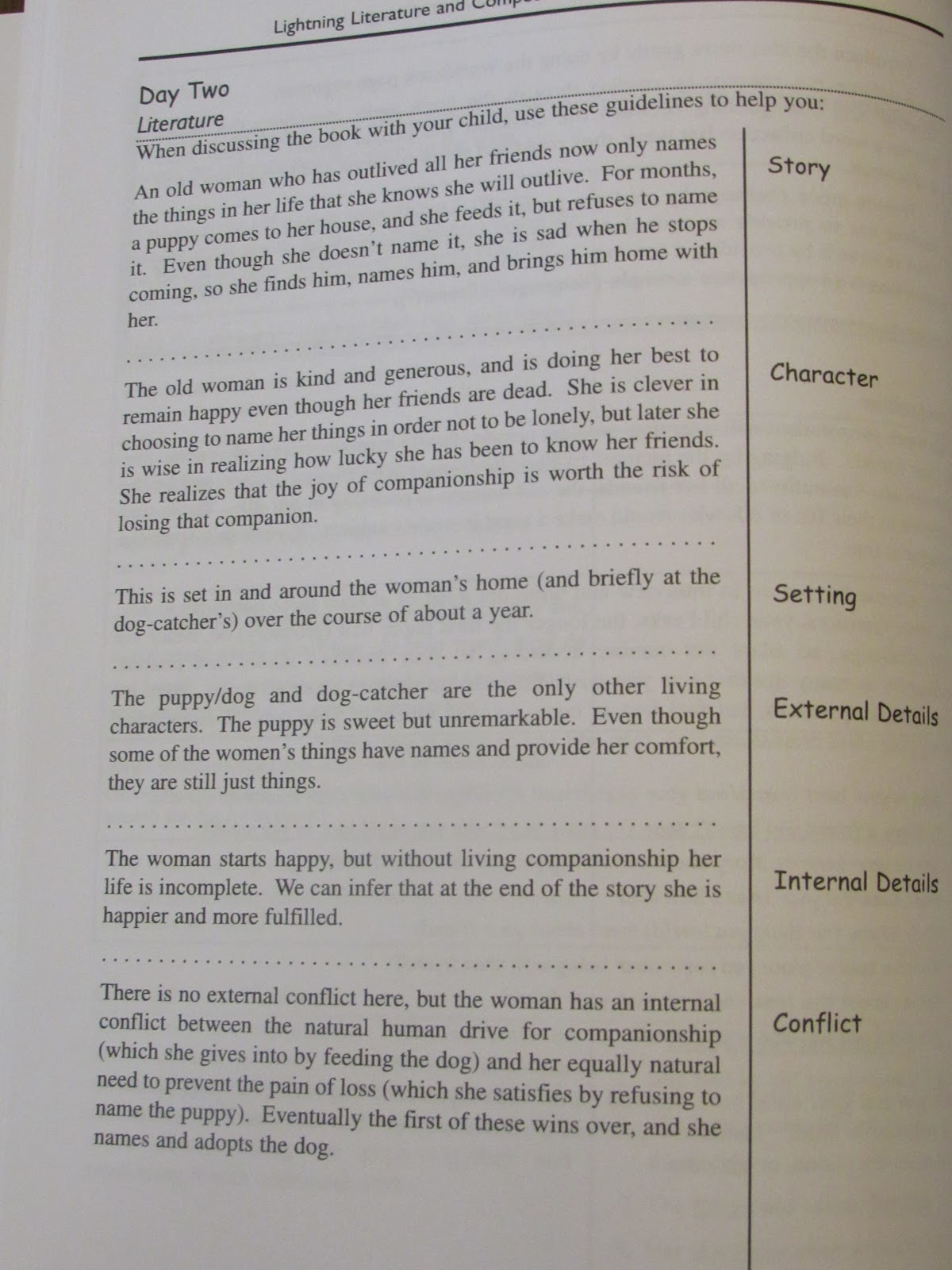
This shows the comprehension questions for The Old Woman Who Named Things. I love that it also includes the answers.


Guidance is given for discussing the book on Day 2. The idea is to help your child touch on the Story, Character, Setting, External Details, Internal Details, and Conflict, without really using those words.


Answers are also given for the workbook pages.


You will also find daily instructions for writing the week's composition. 

Even though we decided to do the optional word collection, or "Word Book" as we are calling it, we also did Week One's composition assignment, which was not required. We were to use the last line in Max's Words to create a story. Harold dictated a story to me, then I typed it out and printed it in large font for him to cut apart and glue to pages. Here he is, working on illustrating his story.


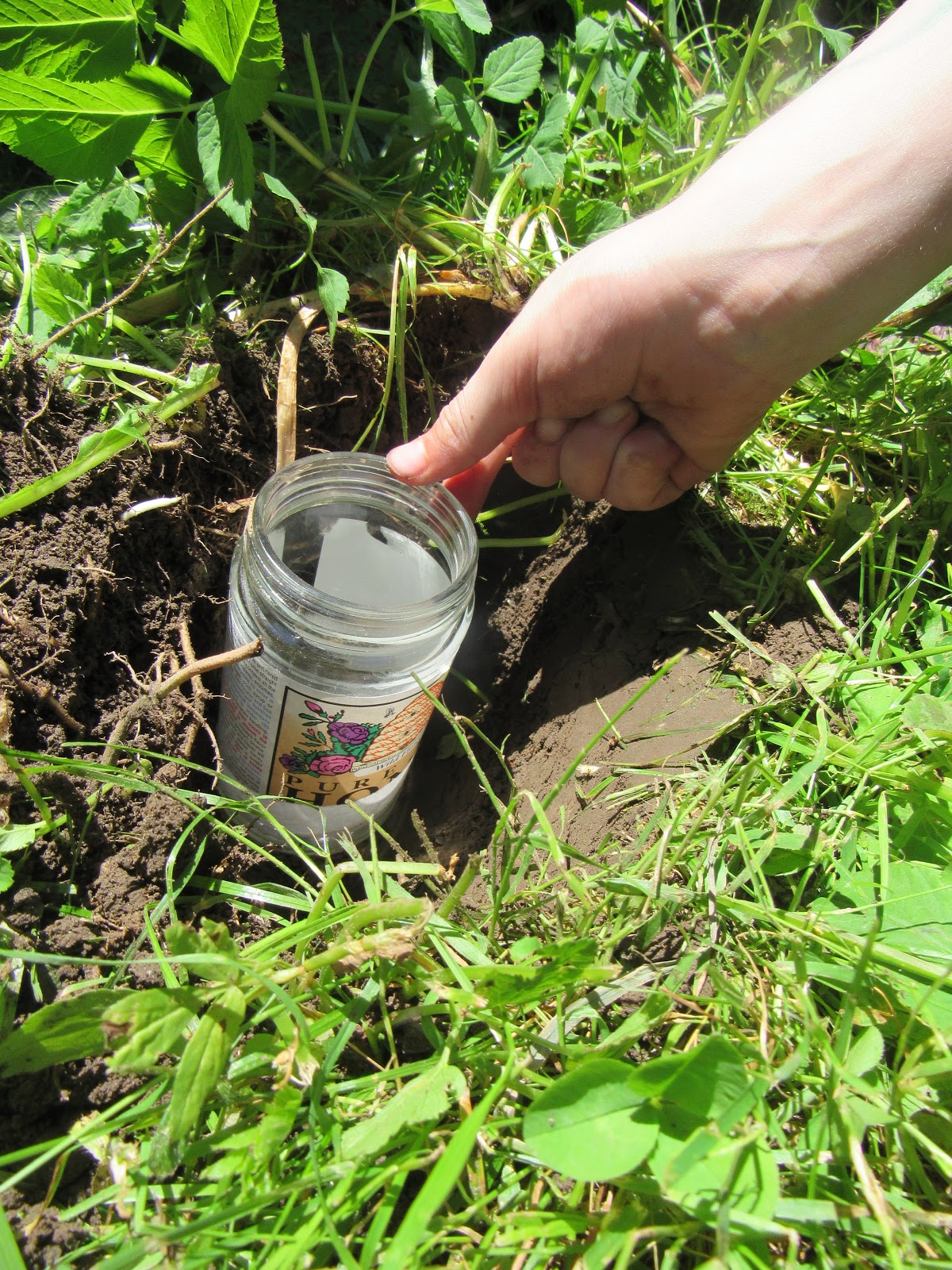
Each week there are also extension activities. In Week 5 there are tons of suggestions right in the Insect Detective book that we are to choose from. Harold decided he wanted to dig a hole in our yard and place a jar inside it to see what kind of insects we could discover.


All-in-all I absolutely love Lightning Lit Grade 2. I love introducing my children to new literature selections. I've found some new favorites myself and have wondered why I had never heard of some of these books. We get to discuss the books and work on English skills in fun ways. This program is engaging and comprehensive, it has varied activities, including hands-on fun. I highly recommend Lightning Lit Grade 2.

I also invite you to read what I had to say about Grade 1 and Grade 3. Hint: they were great too!

You can find Hewitt Homeschooling Resources on Facebook, Twitter, Pinterest, YouTube, and Instagram.

Don't forget to click on the banner below to see what my fellow Crew Mates had to say about various levels of Lightning Lit  (both elementary and junior high grade levels), plus other courses Hewitt Homeschooling Resources has available. 

Lightning Literature, My First Reports, State History Notebook & Joy of Discovery {Hewitt Homeschooling Resources Reviews}
Crew Disclaimer

Wednesday, March 9, 2016

Enjoying Writing With the Homeschool Writing Program From Here to Help Learning {A TOS Review}


I love reading and I love writing. When I was a child I always dreamed of becoming an author. However, my writing skills were never what I needed them to be. This became a concern to me as the children have gotten older, because I want to make sure to give them the guidance they need when it comes to their writing. Tabitha has shown a distinct interest in writing stories, from quite an early age actually, and I want to be able to guide her properly. That is why I am so glad there are neat programs like Here to Help Learning available for homeschoolers. We have been spending the last several weeks using Here to Help Learning's Flight 1 Paragraph Writing, and I am so excited to be able to share about it with you today.


This online subscription writing program for homeschoolers is taught by veteran homeschooler Beth Mora. While we as reviewers received the online subscription, there are also physical sets that are available for purchase. 


All of the components of the physical set are available in the online subscription. We are able to watch the videos on the computer:


And we are able to view and print the student worksheets and teacher guide/scripted lesson, along with additional resources.


In this way, we can use the online subscription with as many children as we would like. We do have to print out the worksheets for each child, so in addition to having internet access, you will have to have a printer with a good amount of ink. A 1-inch binder with dividers is also required. Some other general supplies needed include: a pencil. notebook paper, timer, crayons, markers, scissors, tape, glue stick, stapler. As you go through the program you will also need some additional materials, such as construction paper to make essay folders. Fortunately, there is a master supply list which can be found under the resources tab.


As you can see, there are many resources to help you on your writing adventure. 

The Here to Help Writing Program has two levels: Paragraph and Essay writing. We started with Paragraph Writing as it is designed to be used by children in grades 1 through 3. Essay writing is meant for 4th through 6th graders. Each level also has 3 flights to choose from. It doesn't really matter which order you do the flights in, though it is recommended to complete Flight 1 or 2 of the Essay writing level before doing Flight 3 as Flight 3 is a "Write a Book" Project.  

I like that this curriculum can be used for a mixture of ages. The younger children can write less or dictate to the parent, while older children are to write more and they are to be more independent. I've done parts of the program with Hannah and Harold by having them dictate their story to me.  This program can also be used in a co-op setting. I would have loved to do this, but we don't have decent internet access at the camp where we attend co-op. 

Each Flight is meant to take 1 year. There are six projects in each Flight, and each project has several lessons, each of which is meant to take 1 week. During that week, there are 2 days worth of work. Here, let's take a closer look at what a lesson looks like:

  • Pre-flight checklist: Getting ready for the lesson, making sure all supplies are ready.
  • Flight check-in: Handing in "Flying Solo" work, receiving Discovery Tickets, adding new worksheets to binder. Reciting memory verse.
  • Take Off: Playing games that focus on English/writing skills, doing the Writing Warm Up, and going over the Writing Process.
  • Full Throttle: This is where the week's writing lesson for the project is taught.
  • Flying Solo: Working on the assignment.
We have actually been breaking the lessons up into 3 separate days of work instead of 2. The girls gather their binders and come to sit in the living room. I check over their "Flying Solo" work and hand out the Discovery Tickets. I then hand out the new worksheets for them to put in their binders. 


We then recite the memory verse.


We then move into the "Take Off" section of the lesson. During the duration of a project (which if you remember is several lessons long) there is a game that is played. For Project #1: All By Myself, we have been playing Sentence-No Sentence. When we move on to our next project, we will get a new game to play. 

The first time we are introduced to the game, we see it played by children on the video. However, during the remainder of the lessons we are expected to remember how to play, which is simple enough because one of the worksheets the girls put in their binder explains how to play.


Our final activity for the first day of a lesson is the Writing Warm Up. The girls really enjoy this section of this program, so I give them 10 minutes instead of 7 to finish their story. We are given a picture to write about and the girls take turns giving me relevant words for the word box, words that will help them write their story. 


They then need to determine if the picture takes place at the beginning, middle, or end of their story. Younger children could choose to just copy the words or add some more words about the picture. They could also write some sentences about the picture. I do expect my girls to write a story that includes a beginning, a middle, and an ending. I allow the older girls to work independently while I work with the younger children. This is a bit different than the instructions, as we are told to be there to write down correct spellings to unknown words. I have told the children to spell the words as best as they can, this way, when I look back I can see which words they were struggling with and I can then include them in their spelling word lists.


I have to admit, I have also enjoyed writing my own story for the Writing Warm Up. After everyone has finished writing their story we read them aloud.


On the second day of the lesson we watch the Full Throttle section of the video. We learn the part of the Writing Process that is being focused on in that lesson. Then on the third day of the lesson they finish their assignment. 

We learn the following steps as we make our way through the project:
  • Brainstorm
  • Make a List
  • Webbing
  • First Rough Draft
  • First Input: I Can Help (Content Focus)
  • Second Rough Draft
  • Second Input: I Can Help (Grammar and Spelling Focus)
  • Final Recopy
  • Publish
For this first project the children had to think of something they learned to do. We started with brainstorming different ideas. Then they needed to pick one they wanted to focus on. Tabitha chose to write about learning to cook an egg sandwich, while Amelia decided to write about learning to bake a cake. 


The second step, which would come the following week, is to list the steps it took to learn the skill. This was definitely harder for Amelia to do than Tabitha. 


They then needed to organize their thoughts by placing them in order on their webbing sheet. 


Because we are taking extra time for each lesson, we are just now getting to the steps where they need to write the draft of their paragraph. I think I may have to start having lessons 3 days out of the week so we can still finish a lesson in a week. Otherwise we won't finish the Flight in a year. 

We have very much enjoyed working on writing skills with Here to Help Learning. I am excited to continue through the year with the children. It is such a fun way to learn the different concepts. They learn with games and being able to write fun (and funny) stories. I think it is great to have so many opportunities to go through the writing process. Throughout the year, children will have the opportunity to explore different genres of writing such as: narrative, descriptive, expository, and persuasive, as well as working on poetry. Above all, I LOVE that there is a Christian focus. The children are constantly being reminded that their writing should be done for the glory of Christ and are being reminded about watching their attitudes. I highly recommend this writing curriculum. 

You can find out more about Here to Help Learning at their social media sites. 

Twitter: https://twitter.com/HTHLTweets
Pinterest: https://www.pinterest.com/HTHLearning/ 
YouTube Channel: https://www.youtube.com/user/HereToHelpLearning

Don't forget to check out what my fellow Crew Mates have to say about this program. Just click on the banner below:


Here to Help Learning Review

Crew Disclaimer
Related Posts with Thumbnails