Wednesday, November 13, 2019

Historical Fun with the Horses in History Series {A Homeschool Review Crew Review}


I've mentioned before that I love finding new books for the children and I to read. I've also mentioned that Amelia is a fan of learning about history. So, when I learned about Mattie Richardson's Horses in History Series from Author Mattie Richardson/Appaloosy Books, I thought they would be a great read. What made it really good timing is that we are learning about early American history in our homeschool this year. Granted, we are learning about colonial times currently, and these books take place in the 1800's, but I thought they would be fun to read and have on hand for when we reach that period of history. 


We received four paperback books which range in length from 70 pages to 140 pages. 


The author, Mattie Richardson, wrote the first book, Appaloosy, when she was only 13 years old, though it wasn't published until she was 16. Since then she has written five more books. I love her passion for writing and for encouraging other young writers. She is also a musician and of course, she owns a couple of horses and enjoys horseback riding. Even more amazing, she finds time to go and speak and perform Bluegrass. Her four books in the Horses in History Series are:
  • Appaloosy
  • Dusty's Trail
  • Golden Sunrise
  • Day and Night

What really intrigued me about these books is that they are written from the point of view of the horse or horses (as is the case in Day and Night). And though the stories revolve around the personal life of the horse(s) and the owners, there are tidbits of history being learned as the books are being read. 

You do not need to read the books in any particular order, and they are not connected with each other. They are stand-alone novels which focus on different periods in American history. 


In Appaloosy, we are introduced to the main character, Storm the Appaloosa, at his birth. He is the son of Blackhawk and Misty. This story takes place in 1877 during the Nez Perce War. At first Storm thinks he is a free horse, but soon learns that the Nez Perce Indians owned him and many other horses in the area. His life is a series of struggles in wanting to be free while being owned by different people, some more loving than the others. Even though he resisted being "owned" by the Indians, he developed a relationship with the young brave named White Feather who he was given to. Sadly, they are separated due to the Nez Perce war when the white man comes to force the native people onto the reservation. He finds himself taken away by the soldiers, refuses to be broken, and ends up escaping, only to be caught and sold more than once. He then goes from his cruelest master to his sweetest, most gentle owner, a girl named Faith who earns his trust and loyalty. There are still struggles, including a fire, an accident, and a horse-napping, but he finally comes to the realization that he wants a home and chooses to remain loyal to Faith. 


In Dusty's Trail, we go back a decade to the time of the Pony Express which ran from April of 1860 to October of 1861. Our main character Dusty is unlike Storm from the first book in that he was brought up to know he was an owned horse. He is an American Quarter Horse was already broken and enjoyed spending time with his owner. We are introduced to him, as well as his owner Levi, as they are racing down a dusty Nevada valley. We come to learn that Dusty is extremely fast, yet he is a bit of a fraidy cat. And we learn that Levi is a bit rebellious, though he means to do well by his family. Against his mother's wishes, Levi answers an advertisement to become a part of the Pony Express. We learn how the Pony Express ran, with the rider going from horse to horse before taking a break. This of course means that Dusty wasn't always with Levi. Though Dusty worked well with other riders, it was said that they did their best work together. In fact, Dusty ran an extremely long run at one point because of sickness and death of others. This of course puffed Dusty up with pride, which was then punctured when he and Levi were attacked by Pauite Indians and he abandoned his master who was captured. Thanks to the help of a horse named Ace who used to be owned by some Indians, Dusty is able to rescue Levi, becoming brave in the process. 


In Golden Sunrise, the author takes us back further in time to the early 1800's during the time when Texas is fighting for its independence. In this book the main character is a female Palomino horse  named Cheyenne. We meet her and her owner Jared as they are playing in a meadow in Northern Texas. Cheyenne originally belonged to an Indian but was sold to Jared a few years prior to the start of the book. I look forward to reading this book and to learn more about the Texas fight for independence through the eyes of Cheyenne. I have to say, I was excited to learn that Davy Crockett is a character in this book. When it comes to historical information that I have knowledge of, this book is one that includes some I actually already know about. 

But, I have to say, I know the most about the history that is covered in the fourth book, Day and Night.


That said, I have not yet had a chance to read this book. Personally, I have fully read Appaloosy and Dusty's Trail. Tabitha and Amelia are part-way through Appaloosy, though with their other reading for school they haven't had a chance to read it as much as I would have liked. Unfortunately, Amelia isn't as "into" the book as I was hoping she would be. I, on the other hand, am really enjoying them and can't understand why she doesn't care for the book. Though I have not yet read Day and Night, my husband agreed to read it to be able to share his thoughts. 

This is the only book that is told from the alternating point of view of two horses who happen to be brothers, one fighting with the Union army, and one fighting with the Confederate army. Personally, I am used to books like this, so I think I would be okay with it; however, my husband has found it a bit confusing. Other than that, he seems to be enjoying the book.

I think this book is one the children and I will read together as a read aloud when we get to the time of the Civil War (the time period it is set in). I'm especially excited to get to use the Day and Night Enrichment Guide for this Day and Night book. 


The Enrichment Guide is broken up into 8 sections which are meant to be taken at a pace of about one section a week. There are reading comprehension questions, vocabulary, history information, a look at soldier's life, geography, horses and history, biography, and even a section to work on the students own writing skills. It looks like this will be a great way to delve into the Civil War. 

I have really been enjoying these books. Personally, I have always loved horses, and it is neat to be able to read these stories from the horses point of view, learning more about horses and the care of horses at the same time. I really enjoy all the historical information that is included in the books, and appreciate the time the author took researching this information. Additionally, the "Blast from the Past" section at the end of each book is a great resource.

I also like that there are some illustrations in the book, though there are only a few in each book.


I definitely recommend these books to those who are lovers of horses and/or American history.

You can find Appaloosy Books on Facebook, Twitter, and Instagram.

Don't forget to click on the banner below to see what my fellow Crew Mates thought about these fun books.


Book Set: Appaloosy, Dusty's Trail, Golden Sunrise & Day and Night {Mattie Richardson/Appaloosy Books Reviews}
Crew Disclaimer

Friday, November 8, 2019

Littles Learning Link Up: Dissecting Owl Pellets


Littles Learning Link Up is now on Friday!!

Each month you will find:
  • A seasonal round-up (usually toward the beginning of the month)
  • Posts where I share what I have been up to with my elementary-age children and the preschoolers I work with at our homeschool co-op (including occasional highlight posts where I share how we used ideas that have been linked up here on Littles Learning Link Up).
Each week, I will host a link up, where you can share either what you have been up to recently, or old posts that may go with the theme.  Feel free to link up more than one post.

Each week I will continue to feature a couple of posts from those that have been linked up. 

I hope you will continue to share your wonderful posts, and I hope you will find something new to try with your child(ren).

It would be great for everyone to stop by and visit the other linked-up posts as well. Check them out, leave some comments, pin those that interest you. Let's make this a real party and socialize with each other.

Here's a peek at what we have been up to in our homeschool.

We haven't been doing the greatest job getting back on track with our school times. Tabitha usually gets her history reading in, but I don't always get to it with the other children. They do get math and language arts done as this is done during their computer time. And for November, Language Arts is writing their story for NaNoWriMo. I have also been able to get the younger two to work in the math workbooks, plus Harold has a science workbook. Additionally, Tabitha is reading The Witch of Blackbird Pond, and I am reading, as a family read aloud, Charlie and the Chocolate Factory. Though both of these are being used with the LitWits Kits we are reviewing, Tabitha was scheduled to be reading The Witch of Blackbird Pond anyway, as it goes with our time period in history, colonial America. 

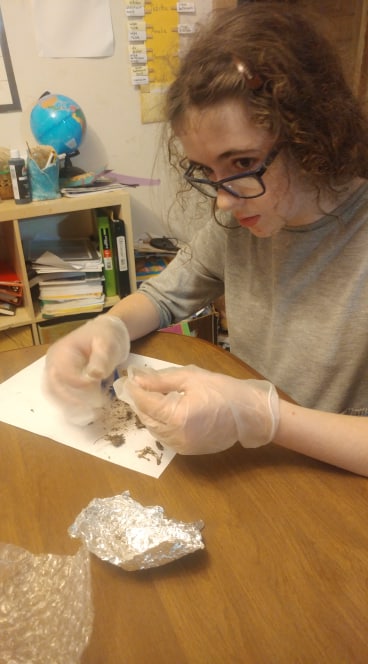
Something we did make time for was dissecting owl pellets. 

This kit was really neat, I got it off of Amazon.


It came with 6 barn owl pellets, one for each of us, though daddy hasn't dissected his yet.


The children were hesitant at first. Actually, they were completely grossed out at the thought and were refusing to do this. However, once they got started they were quite fascinated, even little Harold.


I mean, it is quite fascinating.


There, a little look at the bones we found.

Let's take a look at that review schedule real quick:

Last week I posted my review of a multiplication practice book from Channie's Visual Handwriting & Math Workbooks.

And this week I shared my review of the new books from Kregel Publications, the Goldtown Beginnings books featuring Jem Coulter. Later in the month I will share reviews of some books from Mattie Richardson,  Elephant Learning Math Academy, and LitWits Kits.

Here are some things I would like to share with you:


Now onto:
Littles Learning Link Up Features

On my last Littles Learning Link Up post, there was only 1 wonderful post linked up. 

Please, don't forget to stop by other posts that are linked up. See what catches your eye, stop by, pin the post to a relevant board, and perhaps leave a comment to let the author of the blog know you have been by for a visit. I know I appreciate others commenting and letting me know they have read my posts, so I am sure others do too.

Here's this week's featured post is:


Homegrown Adventures shared Albuquerque, New Mexico Road Trip
.
Join the Party!

I would love to have you join in this week! What sort of activities do you do with your young children? Do you have some favorite activities you would like to share? I invite you to link up below. I will be pinning posts on one of my relevant boards, and I would love to feature some of the activities each week from what is linked up.

Please know I may share a picture from your post and link back to it, along with sharing how we used your idea in our school time. By linking up you are giving me permission to use a picture from your post. I will ALWAYS give credit and link back. Additionally, if you choose to try out any of the ideas with your child, please make sure you give credit where credit is due.

Linky will be open through Monday night, to give me time to check out all the posts and get the Features organized. Please take the time to visit some of the other wonderful posts linked up.

No button currently, and there won't be one until I can figure it out seeing as Photobucket has changed things. Feel free to still share the picture in place of the button. Just link it to my Littles Learning Link Up permalink please.


I am sharing over at

Homeschool Coffee Break


You are invited to the Inlinkz link party!
Click here to enter

Wednesday, November 6, 2019

Entertaining Reading with Goldtown Beginnings from Kregel Publications {A Homeschool Review Crew Review}


I love finding new books for the children to read. Especially the children who don't get into reading as much as I would like. When I learned that there was a new series coming out by Susan K. Marlow, I was quite excited. Especially because one, it is a series for younger children (ages 4-8), and two, the main character is a seven-year old boy named Jem (short for Jeremiah), though his younger sister Ellie plays a decent roll in the books as well. The first two books in the series are titled, Jem Strikes Gold and Jem's Frog Fiasco. They are published by Kregel Publications, just like the Circle C Stepping Stones books that feature Andi, which we reviewed a couple of years ago.

When I first learned about these books, I asked Harold (my seven year old) if he would be interested in reading them. He seemed quite excited, so I was thrilled when we were notified that we were on this review. These are the first two books in the Goldtown Beginnings Series, and let me tell you, he can't wait until the next books are available. 


The series tells the story of a young Jem Coulter. Jem is the main character in the Goldtown Adventures series for older children. It takes place during the Gold Rush, in the town of Goldtown, CA. Jem and his sister Ellie live with their Mama and Pa on a claim along Cripple Creek.


Both books are paperback, 5x8 inches in dimension, and 80 pages in length. 

Let me tell you a bit about each book.


In Jem Strikes Gold, we are introduced to the two children as Jem is panning for gold in his own little claim on the families claim. Like most gold prospectors, they aren't striking it rich, but finding little bits of gold flakes now and then. In fact, it was a little speck of gold that Jem was trying to retrieve from him pan when the story opens. Their family actually makes ends meet from the jobs their Mama does, such as selling her homemade pies and doing laundry. The children are kept busy by helping deliver the pies and transporting the laundry, when they aren't in school or trying to find their own gold. Jem does his best to be a good big brother, and he also tries hard to remember to be kind. Which isn't easy when there is a bully to contend with. Every Saturday the children are supposed to help deliver pies, but Will Sterling like to harass them. Of course, he is the son of the owner of the gold mine, and the richest kid in town. Poor Jem feels quite inferior and bullied due to having to deal with Will. Will even caused Mama's pies to be ruined, and the laundry to spill on the road and get dirty, making more work for their Mama. 

The children's lives are made more interesting when a neighbor gold miner comes back after a long absence and has brought along a stray, starving puppy he found. Of course, the children want the dog to belong to them, and Strike (a.k.a. Strike-it-rich Sam) would love for them to have him. Unfortunately, due to finances, the children are not allowed to keep him. To the parents' dismay, the puppy keeps making himself a part of their life, and a nuisance. However, when he comes to the rescue when Jem is again dealing with Will, he's looked upon a bit differently. 


Jem's Frog Fiasco begins three weeks after the first book ends. Mama still isn't thrilled with the idea of the dog, both with the thought of it being in the tent, or with precious food being given to him to eat. Jem is determined to feed the poor dog, who now goes by the name Gold Nugget, or Nugget for short. Jem gets a job with Mr. Sims, the cafe owner. His task is to catch bullfrogs and he earns five cents for every one he catches. One day, while out catching frogs, Ellie scares the frogs away and Jem yells at her, causing her to run off and get lost. She ends up falling into a coyote hole. Jem finds her after listening to Strike's advice and with the help of Nugget. 

Both books also contain a couple of other features. After the Table of Contents you will find a "New Words" section which highlights some words that might be unfamiliar to the reader, along with the definitions. And the books conclude with a "Peek into the Past" section. Jem Strikes Gold takes a closer look at "Gold," explaining a bit about the gold rush, and Jem's Frog Fiasco looks at "Coyote Holes" which, though mentioned in both books, play a more significant role in the second book.

In addition to these educational features, we were able to download learning activities from the website. Even though Harold read the books on his own, we spent some of our "mommy-time" reading the books together while he filled out the worksheets. We were able to work through them faster than scheduled. Working on a few chapters at a time (unless I fell asleep reading). There are comprehension questions, vocabulary activities, map work, even a maze (which Harold loved).


Harold absolutely loves these books. 


They kept his attention and he was able to get through each book in just a matter of days. Which is good for him, especially because he rarely finishes a book when he starts. it. In fact, he has read both books twice already! That has never happened. He has never reread a book. And this is in addition to me reading a few chapters to him aloud each day we had mommy time. He can't seem to get enough of these books. As I said at the beginning of the review, he can't wait for the next books to be available. And he really seems to enjoy working on the worksheets as well. Which is amazing, as he usually complains about doing schoolwork. He remembered enough about the story, that he could answer the questions before I even got to the answer in my reading. 

Personally, I think the books are wonderful. The stories are great for both boys and girls. I even had Hannah read the first book to determine her interest level. She was able to zing through the first book in under two hours. She seemed quite interested in them, and even wanted to join us in our pie making time in the kitchen. This was actually Harold's idea, as the pies play a significant roll in the story.


Yummy Blueberry Pie!


You can find Kregel Publications on Facebook, Instagram, and Twitter. You can learn more about Circle C Adventures on Facebook.

Don't forget to click on the banner below to see what my fellow Crew Mates thought of these wonderful books.

Jem Strikes Gold & Jem's Frog Fiasco  {Kregel Publications Reviews}

Crew Disclaimer

Wednesday, October 30, 2019

Improving Multiplication Skills with Channie's {A Homeschool Review Crew Review}


I decided it was time for Hannah to start working on multiplication a bit more consistently this year. She's been working on learning her multiplication facts, but I figured she was up for the challenge of learning how to do two-digit multiplication as well. I honestly don't know if I would have thought of pushing her ahead yet if we hadn't been given the opportunity to review the One Page a Day 2 Digit Multiplication Practice workbook from Channie's Visual Handwriting & Math workbooks. As the workbook is designed for children in 3rd through 5th grade, I decided Hannah (my 4th grader) would be the one working through this review product we received thanks to the Homeschool Review Crew. 


We received this 50-page 2 Digit Multiplication Practice workbook.


This soft cover book has pages that are 8.5" x 11" in dimension, like a normal sheet of printer paper. It is one of eleven different math workbooks Channie's has available for elementary aged students. This is in addition to Teacher Reams and the Dry Erase chart. Plus there are also 27 different products available for handwriting. In fact, it was the handwriting pads that started it all. Channie's was born four years ago when Chan Bohacheff realized her son required something to help him practice his handwriting. Two years ago, we had the privilege of reviewing the Easy Peasy Cursive Workbook. Hannah was again the recipient of that review product. If you would like to see what we thought of that workbook, I invite you to check out my review

Like the handwriting workbooks, Chan Bohacheff has incorporated different colors to help visually guide the student in the math workbooks. There are actually three different kinds of pages.

The first 14 pages have only a one-digit multiplier.  The area where the student is to work out the problem is white, then green, then white again.


As you can see, each section is actually broken up into little squares with plenty of space for a child to write the number. The columns are divided by double lines instead of single lines. The tens and ones columns are labeled at the top of the page. The book follows a logical order in that on the first page the child is multiplying every problem by 1, on the second page the child is multiplying by 2, and so on for the first nine pages. Each of these nine pages also follows the pattern of the multiplicand (the first number) increasing by tens from 10 to 90, then back to 10, and from there increasing by 1's from 10 though 19. The page finishes up by having the child repeat several of the same problems from earlier on the page. 


Pages 10-14 give a child practice with random numbers, though I did just notice that pages 10 and 11 are identical.


After practicing multiplication with problems with a one-digit multiplier, the book moves on to two-digit multipliers. These problems now have three colors. In addition to white and green, there are now blue sections. As a child multiplies, they are aware that when they multiply by the number in the ones column they put the results in the green boxes, and when they multiply by the number in the tens column they put the results in the blue boxes. This helps to keep the child from getting confused, especially with the numbers that have to carry to the top. 


The children start out just multiplying by 10 for a full page, then move onto multiplying by 11 for a full page. Then there is a page that mixes the 10's and the 11's, before the book moves on to a more random selection of multipliers. There are 26 pages that follow this format. 

Then the child gets to practice without the colors for eight pages. 


The book concludes with a two-page answer key.


How did we use this multiplication practice workbook?

Well, at the beginning I had Hannah work on it one page a day for a few days a week. I had her use it independently, but then it came to my attention that she didn't quite understand the correct way to be using it and she was struggling. I admit, I would have noticed sooner if I had checked her work every day, but she hadn't expressed any concern or confusion, so I thought she understood. Once I realized she was having problems, I started guiding her through the problems at the beginning of the page, reminding her that there is a multiplication chart on the inside of the front cover,


then letting her go off on her own, if she so chose, to finish the page. But I made sure to check and have her fix any mistakes right away. 


Obviously, this means we didn't get quite as far through the workbook as we could have. However, I feel confident that she now knows what she is supposed to do. At least with one-digit multipliers. We'll be moving on to two-digit multipliers next.

There are a couple of things I did want to mention.

I was a bit surprised that there is no green box on the top of the tens column for children to carryover the number, if needed, on pages with one-digit multipliers. I think that reminder would have helped Hannah, made her realize she was supposed to do something with that digit that belonged in the tens column.

Also, we have found the best way to use this workbook is to take out the page as we are using it and store it in a folder.


There are a couple of reasons for this. First, the pages seem to fall out quite easily, and I don't want to get them lost. Second, when a child flips up the sheet to get to the page on the back of it, the child either needs to fold the book back or reach over the bottom page to work. Folding it back is probably what causes the pages to fall out now that I think about it. But, obviously it would be a bit uncomfortable to reach over the bottom page to work.

Maybe the book was purposely made so that the pages can be taken out for ease of work and are meant to be stored in a folder. Personally, I do prefer to keep a workbook intact if at all possible. Less chance for my children to lose their work.

Even with those little concerns, I think this is a great workbook for children to work on their multiplication skills, especially if they are struggling. The separate colors help to clarify the steps. And they can focus on perfecting these steps even if they don't have all their multiplication facts memorized, as they can use the multiplication chart to make sure each step has the correct answer. If your child  needs help with their multiplication skills, and more clarity while working out these steps, I would definitely advise looking into the One Page a Day 2 Digit Multiplication Practice Workbook from Channie's.

You can find Channie's on Facebook and Instagram

Don't forget to click on the banner below to see what my fellow Crew Mates had to say about this and a few other great Channie's products. 

You will find reviews of 


Alphabet, Number & Sight Word Dry Erase, Neat Numbers & Page a Day 2 Didgit Multiplication. {Channie's Visual Handwriting & Math workbooks Reviews}

Crew Disclaimer
Related Posts with Thumbnails