Showing posts with label Memoria Press. Show all posts

Friday, August 9, 2019

Digging Into Great Stories with Literature Guides from Memoria Press {A Homeschool Review Crew Review}


Thanks to the Homeschool Review Crew, we had the opportunity to review another product from Memoria Press this year. Memoria Press is a wonderful company that provides materials that follow the philosophy of a Classical Education. Though I don't consider us classical homeschoolers, I really do appreciate their materials and found they have added to our homeschool. We have used a variety of their materials from multiple subjects over the past four years. (Wow, has it really been that long since we were introduced to Memoria Press?!?) This time around, we received the Third Grade Literature Guide Set. This set includes the A Bear Called Paddington Literature Guide, the Mr. Popper's Penguins Literature Guide, the Charlotte's Web Literature Guide, and the Farmer Boy Literature Guide. Surprisingly, we actually used all of these guides during this review period. 


We were actually required to use just one of these guides, and I had every intention of using Mr. Popper's Penguins with Hannah as she had received that book for Christmas and was looking forward to reading it. And. . . she was my third grader, so when I requested this level, I was thinking of her. However, when I received the box with all of the guides, I had a sudden inspiration. Why not allow all the children to get involved and give them something specific to do for Language Arts during our Summer Session. Though all of these guides are from the third grade level, I noticed that the books were of various lengths. I figured I could modify as needed for the other children.

I realized the A Bear Called Paddington book would be perfect for Harold and I to work through as it is a bit shorter. I then asked Amelia to work on Charlotte's Web, and Tabitha to work on Farmer Boy independently.


As you can see, we received both a Student Study Guide and a Teacher Guide for all four books. We did have to provide our own copies of the novels. If you were to purchase this full set, the novels would be included. 

So, what exactly will you find in these guides?

The format of each of the guides is the same for all four novels, though the length does vary. 

The Student Guides begin with Teaching Guidelines. There are sections for "Preparing to Read," "Reading," and "After Reading." 

"Preparing to Read"
The teacher (parent) is directed to review and preview before reading the chapter. There are reading notes that introduce the student to key terms. You are also supposed to preview the vocabulary you will be coming across in the chapter. The words are given in context. And you are also supposed to read through the comprehension questions to help you focus as you read. 

"Reading"
Instructions are given on how to read the chapter. You are supposed to mark when you come across each vocabulary word and notice answers to the comprehension questions. 

"After Reading"
This section explains how to work through the sections of the study guide. There are:
  • Vocabulary
  • Comprehension Questions
  • Quotations and Discussion Questions
  • Enrichment
  • Quizzes and Test (These are not actually in the student guide. They can be found in the teacher guide.)
Each chapter then has two pages worth of work.

The Reading Notes section lists several terms/people/places in bold and then gives a definition.
The Vocabulary section prints out a section of the text where the vocabulary word is found, bolding the vocabulary word. Then there are a couple of blank lines for the child to write the definition/synonym. 
The Comprehension Questions section asks questions that can easily be answered from reading the chapter. Three to four blank lines are provided for writing down the answers.
The Quotations section contains a quote from the chapter which can be used while discussing the chapter. Sometimes the student will be asked to answer a question about the quote, such as "Whom is this describing?" or "Who said this?"
There are then Discussion Questions to help you dig a bit deeper. These questions require more thought and may not have one right answer, you have to be able to infer at times. A key to these questions is in the back of the Teacher's Guide. 
And finally there is an Enrichment section. Here your child will complete different activities that may include more discussion, research, writing, or even drawing. 

Spaced throughout the guides are occasional sections to help the student review what has been learned so far. Additionally, all of the student guides except Mr. Popper's Penguins end with an Appendix.

The Teacher Guides begin with those same Teaching Guidelines. Then you will find the section that contains the chapter pages. These are identical to the student pages, except they include the answer keys for the Vocabulary, Comprehension Questions, and the Quotations (if applicable). Toward the back of the Teacher Guide you will find the Teacher Key which includes the Discussion Questions Key, Blank Quizzes, Exam Quizzes, and the Quiz and Exam Keys. The quizzes cover several chapters worth of information, and the Exam covers the entire book. 

So, how did we use these guides?

Harold and I worked on two chapters of A Bear Called Paddington by Michael Bond each week. 


First I read the Reading Notes, Vocabulary, and Comprehension questions to him. 


Then I read the chapter. 


As I was reading, I would jot down the page number where vocabulary words or answers to comprehension questions were found, so we could find them easier when we were ready to fill out the answers. We then spent some time figuring out what the vocabulary words meant (sometimes resorting to using the teacher key for the answer) and what the answers to the questions were. I wrote the answers down for him. Then I read the quotation and we discussed the discussion questions. 

Then we moved on to the Enrichment section. There were usually a few activities suggested. We usually picked one or two to complete. 

Here he is checking out sights in London after using the map found in the appendix.


Later on in the story, Paddington and the Brown family head to the seaside. One of the enrichment activities is to write about an experience at the beach. As the children have never been to the beach, I had Harold narrate a fictional story to me about what he thought it would be like if he went to the beach. I typed it out, enlarged the font, divided it into pages, and printed it out for him to illustrate. Here are the first two pages.


I have to confess, I had forgotten all about the quizzes that are supposed to be done after certain chapters. We actually finished the book and all the student guide activities, and then I flipped back in my Teacher Guide, and saw the quizzes. Oops. So, I sat down with Harold and we worked through the first quiz, which focuses on chapters 1-4. We probably would have had an easier time of it if we had taken it before reading chapters 5-8. I did notice that the guides for Charlotte's Web and Farmer Boy have review pages at the point where they would be taking the test. I sort of wish A Bear Called Paddington and Mr. Popper's Penguins did too. It would definitely be easier to note when the quiz had to be given. At least I am aware this for when Hannah gets to her first quiz.

I didn't want to write in the Teacher Guide, and I am trying to conserve ink right now, so I just took a blank piece of paper and wrote down the answers Harold told me.


Now, onto the guide that I had planned on being the only one I was going to use.

Hannah and I have been working on Mr. Popper's Penguins by Richard and Florence Atwater.


Hannah actually read the book in its entirety prior to starting with the guides. She started as soon as we learned that we were chosen for this review. When she was finished, we started working in the guide, working at about a pace of one chapter (sometimes two) a week. We also had a week of no work when she was at summer camp. So, we haven't gotten quite as far as I was planning to.

We have been doing the "Preparing to Read" activities for each chapter, the same as I did with Harold. Then I read the chapter out loud to her, jotting down the page numbers where answers are found. One of the reasons it is taking her longer to work through the guide is that I am making her work on the vocabulary section independently (or as independently as she can, she does need help sometimes). I do still write down the answers to the comprehension questions for her. I had decided I was going to do this before I decided for sure we wanted to review these guides, because she had balked at the idea of having to all that writing. At first she was thrilled with the idea of the one-on-one time of reading the book. So, I didn't want to discourage her, so I told her I would write down her answers. This has been working out well. 


As I am doing with Harold, I allowed Hannah to choose one or two of the enrichment activities for each chapter. She enjoyed doing some illustrations, such as the Popper family, and this picture of Captain Cook in his new home:


We also spent some time looking up videos of people training penguins. 


Another one of the reasons we are working a bit slower is because we were waiting for the library to get in some books on Captain Cook and penguins for us to read. 

Amelia has been reading Charlotte's Web by E.B. White.


She's finished seven chapters and has made it to her first review section. After she finishes her review she will be taking her first quiz.

She has been working completely independently.
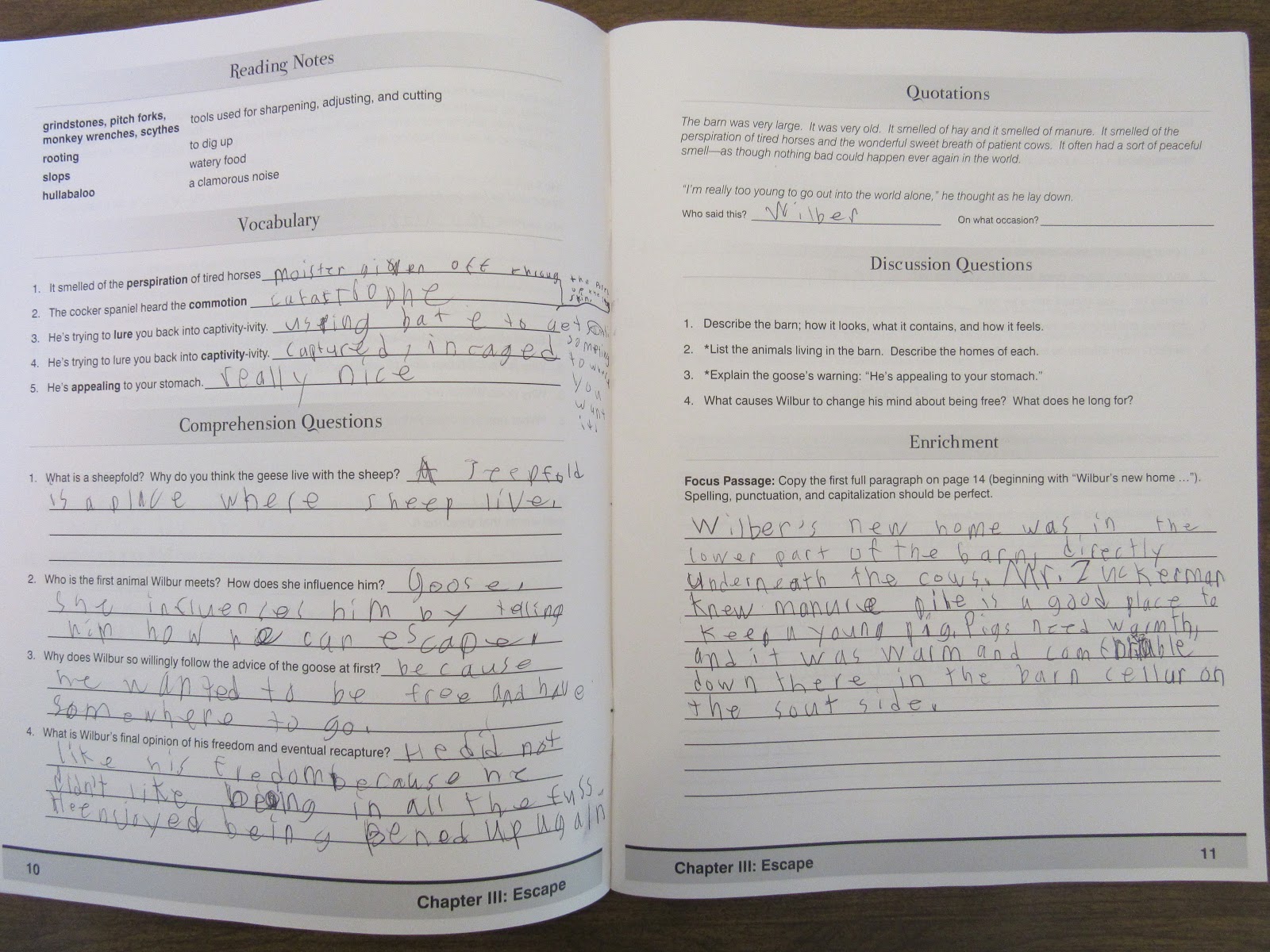

I have noticed that the enrichment activities in this guide tend to be a bit more advanced than they were in the guides for A Bear Called Paddington and Mr. Popper's Penguins. That actually confused me a bit, as they are supposed to be for the same grade. I do know Hannah would be struggling a lot more with these activities than the ones she has been working on.

She probably could have figured out this quotation review; however, I know she would not have been happy having to write out full passages like the one pictured above.


I like that the review pages have the student focus on elements of literature, such as character, setting, and plot. And while working on these elements, the student reviews different types of sentences (declarative, interrogative, and exclamatory). Amelia had to illustrate this storyboard after sequencing the events in the correct order.


The appendix is even more extensive than the one for A Bear Called Paddington. There is a biographical sketch of the author of Charlotte's Web, information about spiders, and there are poems to read, plus a labeled drawing of a spider.

Tabitha is also working through her book independently. Out of all of these books, Farmer Boy is definitely the longest. I've also noticed that it doesn't seem to capture Tabitha's attention as other books have, because she's been reading it a bit slower than her normal pace. As it is summer, I have been a bit lenient, and haven't been requiring her to work at a faster pace. Especially because she didn't ask to do this review. 


She has been getting through about a chapter a week, so she hasn't gotten to her review yet.


As you can see, the enrichment activities in this guide are about the same as they are for the Charlotte's Web guide. Lots of writing. 


She will also get to work on elements of literature, though she has drawing pages to illustrate her favorite chapter previously read, as opposed to doing the storyboards. She will also have vocabulary crosswords to work on as a part of her review.

The Appendix in this guide is quite informative. You will find a biographical sketch of Laura Ingalls Wilder, information of two 19th century primers (The New England Primer and McGuffey Readers), information, including pictures, of farm machinery of the 1800s, illustrations of some clothing from the 1800s, a recipe for Bird's Nest Pudding, plus a couple of poems related to farming. I thought it was really neat that Tabitha already knows these poems, seeing as they were included in the Poetry for the Grammar Stage Set available from Memoria Press that we reviewed back in March.

So, what do we think of these Literature Guides?
I think they are a great way for a student to dig into great stories. Not only are we improving our vocabulary, but we need to pay attention to what we are reading to be able to answer the questions. I appreciate that there are more literal questions, plus questions where we need to dig a bit deeper and learn to infer and think things through. The enrichment activities in the guides for A Bear Called Paddington and Mr. Popper's Penguins were a wonderful way to bring the stories to life. I love the chance to work on geography and delve into certain aspects of the story, such as researching London or Captain Cook. I definitely feel the guides for Charlotte's Web and Farmer Boy work better for my older girls than they would have worked for Hannah as the enrichment focuses more on copywork and literary elements. You don't really get to dig into things like we did with the other two guides.

I would definitely suggest working through these books from easiest to more difficult. This will allow the child to get used to the guides before being asked to do all the copywork. I do realize that the "easier" guides also have writing assignments, but I have allowed the children to dictate to me, which they couldn't do with copywork. 

Harold says he likes that he could answer questions and read the book again. His favorite part was doing the quiz together at the end.

Hannah says she likes that we get to read and draw different things, like Captain Cook's home in the refrigerator.

Amelia liked the literature guide because, "I got to think of things I never would have thought of without the study guide, like how to explain different words that you think you probably knew but when it asks you to explain it I couldn't' do it and had to look it up to see what it meant. I liked the chance to read the book.

Tabitha isn't a huge fan of working through comprehension questions, so she hasn't really enjoyed working through the guide. As a fellow bookworm, I completely understand her preference of just reading to read, as her mother and teacher, I know I have to make her use such things at times. 

All in all, I was very grateful for the opportunity to use these different study guides to enrich our homeschool. 

If you would like to see the other products we have used from Memoria Press, I invite you to check out my Memoria Press reviews. Over the past several years we have reviewed First Start Reading, D'Aulaires' Greek Myths, Latina Christiana Complete Set, Traditional Spelling II, New American Cursive 2, Poetry for the Grammar Stage Set (which I mentioned above), and Simply Classical Writing.

You can find Memoria Press on Facebook, Twitter, Pinterest, YouTube, and Instagram.

Don't forget to click the banner below to see what my fellow Crew Mates thought of the Literature Guides they got to review. You will find reviews for guides for first grade through tenth grade.


First to Tenth Grade Literature Guides {Memoria Press Reviews}

Crew Disclaimer

Wednesday, June 12, 2019

Improving Writing Skills with Simply Classical Writing {A Homeschool Review Crew Review}


Once again we have had the opportunity to review a product from Memoria Press, a company that is pretty well known in homeschooling circles, especially by those who adhere to the classical view of education. While our core curriculum has a classical influence, I tend to be eclectic when it comes to picking curriculum for the children. That said, we have really enjoyed all of the classical products we have reviewed from Memoria Press in the past. I actually just looked back and realized that since 2015 we have reviewed at least one product from Memoria Press a year. This year and last year, we have reviewed two. This time around, I received a set of three books appropriate for 1st through 3rd graders. We received Simply Classical Writing Book One: Step-by-Step Sentences (Bible Story Edition) and Simply Classical Writing Book Two: Step-by-Step Sentences (Bible Story Edition) with Teacher Key by Cheryl Swope.


Just to clarify, seeing as I was a bit confused when we first received our materials, the Teacher Key is just for Book Two. There is no Teacher Key for Book One, which is fine, as there is really no added guidance needed beyond the notes at the beginning of the book. I just wanted to make sure this was understood.

In addition to the set, you will also need a book which contains an introductory and/or comprehensive collection of Bible stories for children. For Book One, A Child's Garden of Bible Stories is recommended, and for Book Two, The Story Bible is recommended. However, it is stated that "any comprehensive collection of Bible stories" can be used, or you can even read directly from the Bible, just make sure to correlate the readings. We were able to find a storybook Bible at the library that has fit pretty well so far, though sometimes we have found that details mentioned in the student guide may vary a bit from what we read.  

Let's take a look at each of the books in the set. 


I have been using Simply Classical Writing Book One: Step-by-Step Sentences (Bible Story Edition) with Harold, my 1st grader. 


This softcover student book is 118 pages in length and contains 34 weeks worth of work. Prior to the lessons you will find a couple of pages of Teacher Notes and four pages of Rules About Sentences which are to be taught to the child. The lessons themselves are all three pages in length and follow the same format. 

Each lesson has a title page with a simple line illustration followed by the "Directions to Follow Every Day." These directions remain the same throughout the entire book. 


Each lesson has the child applying the rules by using three colored pencils. The green pencil is used to circle the beginning capital letter, the red pencil is used to underline the ending mark, and the blue pencil is used to circle proper nouns. 

It is recommended that the "Decodable Sentence" and "Read-Aloud Sentence" be completed on Day One. 


And on Day Two the student should work on "Create a Sentence." 


Then on Day Three the "Challenge Sentence" is to be completed.


And finally, on Day Four, the child is to do "Illustrate" and "Describe Your Drawing."


At this rate, one story is completed per week. However, if your child is finding this pace too easy, you could always accelerate the pace, perhaps taking two, or only one day for each story, so you could fit two or more stories in each week.

I decided to stick with the recommended pace, mainly because Harold does have other writing to do each day, and I don't want to overwhelm him as he does tend to balk at too much writing. 

The book concludes with an Appendix which contains a Certificate of Merit to be given to the child at the completion of the book, and reproducible templates for extra practice.

As we make our way through the book, we will read stories from both the Old and New Testaments. The stories shared are familiar stories, stories that I have found are typically shared with children. We start at Creation, moving on through stories of Adam & Eve, Noah, Abraham, Issac, Joseph, Moses and the Exodus. Then we move into a couple of stories of David, one as a boy, the other as king. There are two stories regarding prophets: Elijah and Daniel. Then, we move into the New Testament. There are three stories from the nativity, then we move into stories of Jesus as a man, performing miracles and teaching. The book concludes with a few stories from the last week of Jesus earthly life, his death, resurrection, and finally his ascension to heaven.

Now, let's look at Book Two:


I have been using Simply Classical Writing Book Two: Step-by-Step Sentences (Bible Story Edition) with Hannah, my 3rd grader. 


This softcover student book is 158 pages in length and also contains 34 weeks worth of work. Prior to the lessons you will again find Teacher Notes and the four pages of Rules About Sentences which are to be taught to the child. The lessons themselves are all four pages in length and follow the same format, though these lessons are different than Book One. The students using Book Two have moved beyond simply writing sentences, and are working on learning different grammar and mechanics skills. 

Each week there are four lessons: A, B, C, and D.

Lesson A has a child apply the rules for sentences along with figuring out which one of three given sentences is the main idea, and which two are details. Children are to use colored pencils to mark the main idea, the same way they do in Book One, though there is an additional color being used, yellow, to underline the main idea. 


Then they are to copy the sentence.


Lesson B has the child work on grammar and mechanics skills. The children are reminded in each lesson that, "Good writing follows the rules of language with great skill." 

As a student works through the book they will focus on the following:
  • The Sentence (Fragment vs. Sentence, Statement, Question, Exclamation)
  • Nouns (Common Nouns, Proper Nouns, Nouns in a Sentence)
  • Pronouns (Male Pronoun, Female Pronoun, All Pronouns)
  • Verbs (Past, Present, Future)
  • Agreement (Articles, Number, Person)
  • Commas & Apostrophes (Commas for Lists, Phrases, and Date, Ownership, Contractions with Pronouns)
  • Synonyms & Antonyms (Synonyms, Antonyms, Choosing a Good Word)
  • Describing (Adjectives, Adverbs, Painting a Picture with Words)
  • Organizing (Organizing, Topic Sentence, A Good Paragraph)
Here is a look at Hannah's work from Week 4 where she was learning about exclamations.


There are also review weeks included throughout the book. Children will review in weeks 11, 12, 22, 23, and 33. Week 34 is a final assessment. 

Lesson C has the student choosing words to create a descriptive sentence related to the week's Bible story. First they choose an adjective to describe a noun, then they choose an adverb to describe a verb. Next they join the two parts, still only writing the adjective and adverb. Finally, the student is to write the entire sentence they created. 


Lesson D has the child illustrate the story and write a couple of sentences to describe the drawing.


There are four different suggested teaching schedules. You can choose to take one, two, three, or four days to complete the "week." We have been working on the Three-Day Schedule as I have two specific days where I have "mommy time" with Hannah, so I can guide her through A and B on the first day, then she can work on C on the second day. I have her work on the illustration and descriptive sentences on the final day, allowing her to take her time on her picture.

As with Book One, Book Two shares stories from both the Old and the New Testament. However, though some stories are the same, Book Two includes additional stories and focuses on different details. Prior to getting into the Old Testament, the first lesson focuses on 2 Timothy 3:14-17 to share how the entire Bible is God's Word. Then we move into Creation, the entrance of sin in the garden, Noah, the promise made to Abraham, the story of Isaac, Jacob's dream, Jacob's family, Jacob's blessings, Moses and the Exodus, plus the time in the wilderness, Joshua and Jericho, Gideon, Ruth & Naomi, and David being anointed king. There are stories from Isaiah and Jeremiah, plus one of the review weeks focuses on Daniel. The remainder of the book focuses on stories from Jesus life. death, and resurrection, plus the early church. The last week is that assessment week. While you are to read about eternal life in Revelation 21-22 and John 20:31, there are no questions about these verses in the student guide. It focuses entirely on what grammar and mechanics skills have been learned.

The book concludes with the Appendix which contains a chart with Week-by-Week themes, Scripture passages, and page numbers for The Story Bible, reproducible Pronoun Visual Aid cards, templates for extra practice, plus a Certificate of Merit.

Finally, let's take a look at the Teacher Key for Book Two. 


The Teacher Key is technically identical to Book Two, except for the fact that the answers are printed in the blanks and highlighted.


How have we been using Simply Classical Writing?

Usually I will work with Hannah and Harold individually during their "mommy time." We will take turns reading the story, with me reading the majority of the story. However, the other day I had the children read the story aloud to each other, with Hannah doing the majority of the reading. Harold is actually a bit further behind, but because of the differences in the stories between Book One and Book Two, their reading was lining up.


Now that we have been using the books for several weeks, the children have gotten pretty good at working independently. Sometimes Hannah will need clarification for the grammar/mechanics lesson, or help in figuring out her descriptive sentence. Harold may also need help with his challenge and/or descriptive sentences. 

I love the way the children are working on language arts skills while focusing on Bible stories. Harold has been able to practice his handwriting while learning how a sentence is to be structured. You would think after several weeks he would remember his punctuation, but we are still struggling with that, so the repetition is appreciated.

With Book Two, I love that grammar and mechanics are taught a little bit at a time while focusing on those same sentence writing skills, consistently reminding the student to use a capital letter when needed plus the correct punctuation. Hannah has also benefited from the handwriting practice. She has told me that she really loves the opportunity to read the Bible stories, and has even asked to continue with this curriculum once our school year has ended. That is most definitely a benefit to me. 

I did just want to touch on the fact that these books are designed for special needs children. Though our children are not special needs, they have both benefited from the slower pace with lots of review and repetition. And I appreciate that the books are not flashy, but have simple pages and illustrations. 

So, whether your children are in need of curriculum that is made for special needs students or not, I would recommend giving it a shot if your child needs practice with forming sentences and would benefit from a gentle way of learning grammar. 

You can find Memoria Press on Facebook, Twitter, Pinterest, YouTube, and Instagram.

Don't forget to click on the banner below to see what my fellow Crew Mates thought of this curriculum plus three other curriculum being reviewed: Simply Classical Spelling (Books One and Two), The Story of the Thirteen Colonies & The Great Republic Set with 200 Questions About American History set, and The War of the Jews set.

Classical Writing & Spelling, American History & Jewish Wars {Memoria Press Reviews}
Crew Disclaimer

Friday, March 29, 2019

Enriching Our Days with Poetry from Memoria Press {A TOS Review}


Thanks to the Homeschool Review Crew, we have become quite familiar with Memoria Press, a family-run publishing company that appears to be quite well known in Christian homeschooling circles. They carry classical curriculum in many subjects, several of which we have had the chance to review in the past. This time around I thought it would be fun to add some poetry into our days, and I was quite excited when I learned that Tabitha would be using the Poetry for the Grammar Stage Set.


The set we received contains three books: The Student Guide, the Teacher Guide, and the Anthology.


This set was designed to be used with Memoria Press' literature study guides as a supplemental study of the poems that are memorized. However, as we are discovering, this set can most definitely be used independently of the literature guides. If we were using this with the Classic Core Curriculum, it would take us four years to make our way through the poems. However, we have been working at a pace of one poem per week, which would mean we could potentially work through the poems in one school year. However, seeing as these poems do become longer and more complex toward the end of the book, it would make sense to work on these later poems at a slower rate. 

Here is a look at the list of poems and the books they would go with:


While we may not be combining this with literature studies, there is a lot to get out of these poems. Tabitha gets to listen to the poems being read, read them herself, work on vocabulary, analyze the poems, answer comprehension questions about the poems, and draw an illustration of her interpretation of the poem. There are quite a lot of skills being worked on with these poetry books.

Let's take a quick look at each of the books in this set.


Student Guide


This 159-page, softcover Student Guide starts with a Table of Contents and a section titled, "How to Teach a Poem," which offers some wonderful tips. From there we move into the actual poem pages. The majority of the 33 poems and their analysis take up four pages each and follow an identical layout. Obviously the longer poems take up more pages.

The poem is printed out on the page, and there is a framed space for the student to illustrate it.


The following page is lined for the student to write out the poem (or part of the poem as is the case with some of the longer poems toward the back of the book).


The next page lists vocabulary words with their meanings. Then the child is to answer some questions to analyze the poem, looking at such things as the rhyming scheme, the speaker of the poem, alliteration, metaphors, and personification. The poem is again printed out, this time with line numbers and a blank at the end of each line to label the rhyming scheme.


Each poem's analysis ends with comprehension questions which expect the child to think about what they are reading. These aren't all simple, find the answer in the poem questions. These questions require the student to give some thought to their answers.


The book conclude with an appendix that contains a glossary, which helps explain different poetry terms, plus a section titled, "The History of Paul Revere's Ride."

Teacher Guide


The 159-page, softcover Teacher Guide is identical to the Student Guide, except for the fact that the questions have answers printed in, and a few of the poems have an inset "Teacher Note" box to help the parent/teacher clarify a specific point.


For instance, in the poem "Try, Try Again" it explains that the rhyming structure included a refrain which was to be denoted with an "R." I actually almost missed this note, as this was the first poem to include one.

Anthology


This 62-page, softcover book is smaller than the guide books. It contains just the poems, some of which have a black and white illustration to go with them.


How did we use these books?

As I've mentioned, we have been focusing on one poem a week. At the beginning of each week I read the poem to all the children during our "Table Time." On another day I will have Tabitha read it. Each week, as we add more poems, I will read through all of them at least once during the week. Sometimes Tabitha joins in with parts she remembers. We will review the vocabulary words to make sure she understands them. Then, during "Individual Time," Tabitha will either head to her room to work on the questions and the copywork, or she will sit at the dining room table. 


I allow her to take the time she needs through the week to work on these pages. She's even been known to work in the van and in the doctor's office. And if she is struggling with the questions, she can come to myself or her dad for help.


I admit, there are times her father and I are just as stumped as she is, so we are quite grateful for the answers that are provided in the Teacher Guide. Poetry is not one of my strengths, which is one of the reasons I thought it would be fun to work through this poetry set. I am hoping to learn alongside Tabitha.

So far we have really enjoyed being able to read and get deeper into these poems. One of Tabitha's favorite parts is being able to add her own illustrations. Honestly, I figured she would enjoy that part of the book, seeing as she is quite the artist. I appreciate that she is slowly learning more details regarding poetry terms, learning them as she comes across them in the poems and works on her analysis. 

I have to admit, I am not sure Hannah (my third grader) would be able to work through these poems the way Tabitha currently is. I was surprised to discover that this set is recommended for 3rd-7th grade. I realize we really haven't focused on poetry in our homeschool, so I can see the possibility of working through these slowly at a younger age, and building on the foundation. However, I'm sort of glad I decided to use it with Tabitha instead of Hannah, as there is a lot of writing that Hannah would definitely have struggled with. 

I'm so thankful that we were given this opportunity to add poetry into our homeschool. And I definitely feel that I can recommend Poetry For the Grammar Stage Set, though perhaps for children in the older part of the grade range as opposed to third or even fourth grade.  Though perhaps children who are used to a classical education would be better prepared for this at a younger age. 

You can find Memoria Press on Facebook, Twitter, Pinterest, Instagram, and YouTube.

My fellow Crew Mates and I were given the choice of quite a few different products for this review. Some of them are reviewing the First Start Reading Program, which we reviewed four years ago. Others are reviewing various levels of Poetry. Still others are reviewing different levels of Latin, ranging from Prima Latina to Fourth Form Latin. We actually reviewed Latina Christiana two years ago.

So, don't forget to click on the banner below to see what my fellow Crew Mates think of these different products from Memoria Press.

Phonics, Poetry & Latin {Memoria Press Reviews}
Crew Disclaimer
Related Posts with Thumbnails