Wednesday, October 30, 2019

Improving Multiplication Skills with Channie's {A Homeschool Review Crew Review}


I decided it was time for Hannah to start working on multiplication a bit more consistently this year. She's been working on learning her multiplication facts, but I figured she was up for the challenge of learning how to do two-digit multiplication as well. I honestly don't know if I would have thought of pushing her ahead yet if we hadn't been given the opportunity to review the One Page a Day 2 Digit Multiplication Practice workbook from Channie's Visual Handwriting & Math workbooks. As the workbook is designed for children in 3rd through 5th grade, I decided Hannah (my 4th grader) would be the one working through this review product we received thanks to the Homeschool Review Crew. 


We received this 50-page 2 Digit Multiplication Practice workbook.


This soft cover book has pages that are 8.5" x 11" in dimension, like a normal sheet of printer paper. It is one of eleven different math workbooks Channie's has available for elementary aged students. This is in addition to Teacher Reams and the Dry Erase chart. Plus there are also 27 different products available for handwriting. In fact, it was the handwriting pads that started it all. Channie's was born four years ago when Chan Bohacheff realized her son required something to help him practice his handwriting. Two years ago, we had the privilege of reviewing the Easy Peasy Cursive Workbook. Hannah was again the recipient of that review product. If you would like to see what we thought of that workbook, I invite you to check out my review

Like the handwriting workbooks, Chan Bohacheff has incorporated different colors to help visually guide the student in the math workbooks. There are actually three different kinds of pages.

The first 14 pages have only a one-digit multiplier.  The area where the student is to work out the problem is white, then green, then white again.


As you can see, each section is actually broken up into little squares with plenty of space for a child to write the number. The columns are divided by double lines instead of single lines. The tens and ones columns are labeled at the top of the page. The book follows a logical order in that on the first page the child is multiplying every problem by 1, on the second page the child is multiplying by 2, and so on for the first nine pages. Each of these nine pages also follows the pattern of the multiplicand (the first number) increasing by tens from 10 to 90, then back to 10, and from there increasing by 1's from 10 though 19. The page finishes up by having the child repeat several of the same problems from earlier on the page. 


Pages 10-14 give a child practice with random numbers, though I did just notice that pages 10 and 11 are identical.


After practicing multiplication with problems with a one-digit multiplier, the book moves on to two-digit multipliers. These problems now have three colors. In addition to white and green, there are now blue sections. As a child multiplies, they are aware that when they multiply by the number in the ones column they put the results in the green boxes, and when they multiply by the number in the tens column they put the results in the blue boxes. This helps to keep the child from getting confused, especially with the numbers that have to carry to the top. 


The children start out just multiplying by 10 for a full page, then move onto multiplying by 11 for a full page. Then there is a page that mixes the 10's and the 11's, before the book moves on to a more random selection of multipliers. There are 26 pages that follow this format. 

Then the child gets to practice without the colors for eight pages. 


The book concludes with a two-page answer key.


How did we use this multiplication practice workbook?

Well, at the beginning I had Hannah work on it one page a day for a few days a week. I had her use it independently, but then it came to my attention that she didn't quite understand the correct way to be using it and she was struggling. I admit, I would have noticed sooner if I had checked her work every day, but she hadn't expressed any concern or confusion, so I thought she understood. Once I realized she was having problems, I started guiding her through the problems at the beginning of the page, reminding her that there is a multiplication chart on the inside of the front cover,

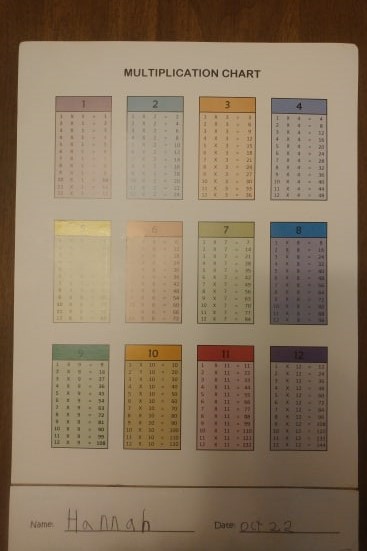

then letting her go off on her own, if she so chose, to finish the page. But I made sure to check and have her fix any mistakes right away. 


Obviously, this means we didn't get quite as far through the workbook as we could have. However, I feel confident that she now knows what she is supposed to do. At least with one-digit multipliers. We'll be moving on to two-digit multipliers next.

There are a couple of things I did want to mention.

I was a bit surprised that there is no green box on the top of the tens column for children to carryover the number, if needed, on pages with one-digit multipliers. I think that reminder would have helped Hannah, made her realize she was supposed to do something with that digit that belonged in the tens column.

Also, we have found the best way to use this workbook is to take out the page as we are using it and store it in a folder.


There are a couple of reasons for this. First, the pages seem to fall out quite easily, and I don't want to get them lost. Second, when a child flips up the sheet to get to the page on the back of it, the child either needs to fold the book back or reach over the bottom page to work. Folding it back is probably what causes the pages to fall out now that I think about it. But, obviously it would be a bit uncomfortable to reach over the bottom page to work.

Maybe the book was purposely made so that the pages can be taken out for ease of work and are meant to be stored in a folder. Personally, I do prefer to keep a workbook intact if at all possible. Less chance for my children to lose their work.

Even with those little concerns, I think this is a great workbook for children to work on their multiplication skills, especially if they are struggling. The separate colors help to clarify the steps. And they can focus on perfecting these steps even if they don't have all their multiplication facts memorized, as they can use the multiplication chart to make sure each step has the correct answer. If your child  needs help with their multiplication skills, and more clarity while working out these steps, I would definitely advise looking into the One Page a Day 2 Digit Multiplication Practice Workbook from Channie's.

You can find Channie's on Facebook and Instagram

Don't forget to click on the banner below to see what my fellow Crew Mates had to say about this and a few other great Channie's products. 

You will find reviews of 


Alphabet, Number & Sight Word Dry Erase, Neat Numbers & Page a Day 2 Didgit Multiplication. {Channie's Visual Handwriting & Math workbooks Reviews}

Crew Disclaimer

Tuesday, October 29, 2019

Littles Learning Link Up: Fall Fire Fighting Craft


Each month you will find:
  • A seasonal round-up (usually toward the beginning of the month)
  • Posts where I share what I have been up to with my elementary-age children and the preschoolers I work with at our homeschool co-op (including occasional highlight posts where I share how we used ideas that have been linked up here on Littles Learning Link Up).
Each week, I will host a link up, where you can share either what you have been up to recently, or old posts that may go with the theme.  Feel free to link up more than one post.

Each week I will continue to feature a couple of posts from those that have been linked up. 

I hope you will continue to share your wonderful posts, and I hope you will find something new to try with your child(ren).

It would be great for everyone to stop by and visit the other linked-up posts as well. Check them out, leave some comments, pin those that interest you. Let's make this a real party and socialize with each other.

Here's a peek at what we have been up to in our homeschool.

We are trying to get back on track with our homeschool. Which has been difficult when I had three reviews due last week and three due the week before that. Tabitha has been getting her history reading in, but I don't always get to it with the other children. Plus Tabitha is reading The Witch of Blackbird Pond, and I am reading, as a family read aloud, Charlie and the Chocolate Factory. Though both of these are being used with the LitWits Kits we are reviewing, Tabitha was scheduled to be reading The Witch of Blackbird Pond anyway, as it goes with our time period in history, colonial America. 

Time to share last week's lesson/craft from co-op. 

We started out by going on the field trip to the fire station with the other classes. I love that our co-op takes this field trip almost every year, because it helps get that "fire safety" requirement out of the way. 

The one guy talks to the children about fire safety and then another gets dressed in his gear and crawls around making sure the children learn how to get a firefighter's attention in a burning, smoke filled building. 


Then they got to see the fire engines and ambulance. They even got to go in them!


When we got back to the camp, we had a short lesson. I reviewed what to do when there is a fire and showed them how to dial 9-1-1. Then we sang a song and recited a rhyme I found on the internet. There are a lot of variations of these, so I do not know where they originated to give credit for the original. 

The children loved the first song and wanted to do it multiple times. The rhyme they weren't as fond of.

I’m a Little Firefighter
I’m a little firefighter on the go
here is my helmet
here is my hose
when I see a fire
hear me shout
turn on the water and put it out


Five Little Firefighters
Five little firefighters
sleeping in a row
Ring goes the bell
Down the pole they go
They raced to the fire
and put out all the flames
then the five little firefighters
went back to bed again

THEN it was time for the craft.

Fall Fire Fighting Craft


You will need:

Cardstock
Brown Construction Paper
Black Crayon (or marker)
Red and Orange Leaves
Acrylic Paint (Red, Orange, Yellow, Light Blue (or blue and white))
Glue sticks
White Glue
Tape
Paint brushes (one with wide bristles another with narrow bristles)
Yellow pipe cleaners cut in half

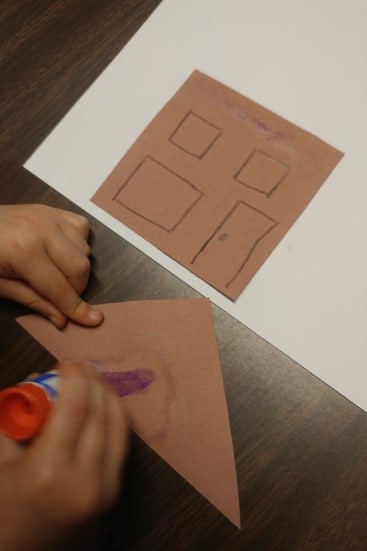
It was very simple to get this craft prepared. All I did was cut out brown squares and brown triangles. Then I drew windows and doors. Again, the same as last week, with older children, more one-on-one time, or just more time, the children could very easily do this step. Both cutting them out and drawing on the windows and doors. If this was a craft I was doing at home with my children, even when they were preschool age, they would have done this step.

Then the children glued the square at the bottom of the cardstock and added the triangle on top. I did draw a smaller triangle on the back, leaving a little edge that is necessary for the next step.  I told the children to glue on the inside of the small triangle. 


Then we went around and put white glue around the outside of the roof so the children could add the red leaves as fire bursting out of the roof.


Then we needed to have the fire coming out of the windows. So, I went around and put a small dab of red, and orange, and yellow paint in each window. The children needed to use the larger paint brush to spread the fire.


We then went around and traced their hands in the corner of the paper. THEY were the firefighters coming to put out the fire.

We made a hole between the thumb and index finger and the children pushed the pipe cleaner in to be the hose.


Then they added blue paint water to put out the fire.


Fall Fire Fighting Craft


These are the books we read.


We also sang our fall songs of course.

Leaves are Falling

(To the tune of Running over)

Leaves are falling leaves are falling
Trees are bright and leaves are falling
Leaf piles we’ll make, we will rake and rake
When trees are bright and leaves are falling


Autumn Leaves

(To the tune of London Bridge)

Autumn leaves are falling down, falling down, falling down,
Autumn leaves are falling down
Lots of colors

Autumn leaves are falling down, falling down, falling down,
Red, and orange, yellow and brown
I love Autumn

Let's take a look at that review schedule real quick:

Last week I posted three reviews. Phew. You will find reviews for Smartick math subscription, the Drawing Program from Creating a Masterpiece, and Excelerate Spanish.

This week I will share my review of a multiplication practice book from Channie's Visual Handwriting & Math Workbooks.

And then in November you will find reviews for new books from Kregel Publications, plus books from Mattie Richardson,  Elephant Learning Math Academy, and LitWits Kits.

Here are some things I would like to share with you:


I'm not sure when I am going to get to that ocean themed round up. Sorry about that. I've been awfully busy with my new venture, being a Pampered Chef consultant.

Now onto:
Littles Learning Link Up Features

On my last Littles Learning Link Up post, there was only 1 wonderful post linked up. 

Please, don't forget to stop by other posts that are linked up. See what catches your eye, stop by, pin the post to a relevant board, and perhaps leave a comment to let the author of the blog know you have been by for a visit. I know I appreciate others commenting and letting me know they have read my posts, so I am sure others do too.

Here's this week's featured post is:


.
Join the Party!

I would love to have you join in this week! What sort of activities do you do with your young children? Do you have some favorite activities you would like to share? I invite you to link up below. I will be pinning posts on one of my relevant boards, and I would love to feature some of the activities each week from what is linked up.

Please know I may share a picture from your post and link back to it, along with sharing how we used your idea in our school time. By linking up you are giving me permission to use a picture from your post. I will ALWAYS give credit and link back. Additionally, if you choose to try out any of the ideas with your child, please make sure you give credit where credit is due.

Linky will be open through Monday night, to give me time to check out all the posts and get the Features organized. Please take the time to visit some of the other wonderful posts linked up.

No button currently, and there won't be one until I can figure it out seeing as Photobucket has changed things. Feel free to still share the picture in place of the button. Just link it to my Littles Learning Link Up permalink please.


I am sharing over at

Homeschool Coffee Break


You are invited to the Inlinkz link party!
Click here to enter

Friday, October 25, 2019

Immersing Ourselves in Spanish with Excelerate SPANISH {A Homeschool Review Crew Review}

One of the subjects that I haven't been consistent in teaching to the children is foreign language. Ever since working at the Montessori years ago, and seeing how well younger children do in learning a foreign language, I knew I wanted to be able to teach them when they were younger, instead of waiting until junior high age, which is how it was for me (and I believe how it typically is). We've worked on it a little here and there; however, with our very busy schedules, foreign language instruction usually falls by the wayside. When the opportunity came up through the Homeschool Review Crew to try out the Excelerate SPANISH Streaming program from Excelerate SPANISH, I thought it would be neat to give it a shot. 


We received a one year subscription to this immersion type program which also includes Total Physical Response (TPR) teaching. There are a total of 48 lessons (24 in Spanish 1 and 24 is Spanish 2). These lessons range in length from 30 minutes to around an hour. Once we were signed up, it was simple to log into the site. 


We "join in" with the class of children who are being instructed by the teacher, Caryn Hommel. Caryn just happens to be a homeschool mom herself, and she has taught ESL for years. Now, let me just clarify, though these are called "streaming videos," we are not joining in with the class live. We are watching the recorded lessons.

As we sit at our computer as students in this "class," we watch as Mrs. Hommel teaches us a LOT of new vocabulary. She shares several words or phrases at a time, writing them on the whiteboard, along with the English translation. She does say the words/phrases out loud so we can hear how they are pronounced.


After she is done writing, she puts her book down and goes down the list, one word/phrase at a time, giving us a motion to go along with it. Sometimes there is a picture or an object to point to instead.


She then asks the children to "show her" a combination of the motions. She asks for them in Spanish. This helps children connect the Spanish word and the motion, to give less emphasis on the English word, so they aren't translating it. Just learning it as they would their native language. You know, like when a baby learns a language, they learn what an object is by connecting it to the word they are hearing. Granted, once children are older, they already know what the English word is, so I'm sure there is a part of their brain that is connecting to the English word as well. I know that is what happens when I try to learn this way, plus when Harold wanted to show me some words, he was showing me the motions, but using the English words because he couldn't remember the Spanish words. 

Here are Harold and Hannah demonstrating the motions for some of the words in the "Going Fishing" lesson. The camera angle switched between the teacher. . .


. . . and the students. 


The words they are learning here are afilados (sharp), los ganchos (hooks), and cuidado (careful).


After she goes over the short list she has written out, she adds more to the board, following the same pattern. Of course, as she goes along, she has more and more words and phrases that she can combine for the children to show her. 

 Then she begins to tell a story with these phrases and she will ask for a student to volunteer showing the words while she says them. 


She then asks everyone to join in with the motions.


And then they actually act out the story from beginning to end. She has read the entire story to us in English, so we know what is going on, then she does it in Spanish.

In the screenshot below, the boy is playing "Roberto" and the girl is playing "Anna." They have been waiting for a bus and a taxi comes along. Anna was going to get in the taxi, but Roberto runs faster and gets in the taxi first. 


Then at the end of the lesson, she reads the story again while everyone does the motions. This is repeated again. And then at the end the Mrs. Hommel makes the motions and asks the students to tell her the story in Spanish. So, the story is repeated multiple times in an attempt to learn it. 

There is also a section in the middle of the lesson, and one at the end, where the children on the video pull out their workbooks to review the material learned. We did not have access to these books as a part of this review. So, we can only listen while they go over it. We try to understand what Mrs. Hommel is saying, but it was quite difficult. I do wish the workbooks had been a part of the review. It was said that the books were optional, but it sure would have been easier to follow along. 

The other problem we had, is that, when the teacher was speaking to us fully in Spanish, she was using words we hadn't learned yet. This, of course made it even more difficult to follow along. I do understand that that is a part of the immersion method of learning, but it is very frustrating to me, and as I have learned, it is frustrating to my children as well.

Due to the fact that we are having trouble with understanding and retention, we have been moving very slowly through the program. We definitely need multiple viewings of the video lesson to be able to understand. And, because the lessons are on the long side, we've been breaking them up and watching them on different days. So, we are still only on lesson 2: Going Fishing. Being able to go to the Quizlet site and practice the vocabulary is quite helpful.

Even though we are only on lesson 2, and we know it is going to take us a while to make it through Spanish 1, I did want to share a little bit about Spanish 2.

From what I could tell, it has more of a classroom feel to it, because they seem to be in a real classroom, as opposed to the room which appears to have been in Mrs. Hommel's house from Spanish 1. I'm not sure if she gets into grammar in Spanish 1 toward the end, but it definitely is present immediately in Spanish 2. She seems to follow the same teaching method, of teaching words and phrases and having the children do motions, but when they tell the story, they have costumes. And there are even graphics included in the video. 

Things I love about this program:

I love that it is interactive. The children use motions to join right in with the students on the video. The inclusion of Total Physical Response (TPR) teaching is a wonderful way to help children memorize things. We have used motions or sign language since the children were toddlers while memorizing our Bible verses. That added movement really does help make connections in the brain. Honestly, it was what drew me to this program. I was like, "Hey, that's how I like to teach."

I love that we get to hear the Spanish words being spoken. I mean, sure we can see them written out in a book or workbook, but being able to watch a video of the words being spoken, while seeing them written as well, is wonderful. 

We are using quite a few of our senses and types of learning styles while using this program. Movement, hearing, and seeing (both the motions and the words).

I love that the words and phrases join together to tell a memorable story.

I love the repetition. And because we are viewing these, we can watch them again and again, repeating the information even more. 

Things I wasn't quite as fond of:

I mentioned that I loved the stories; however I did question the relevance of a story of waiting for the bus and running for the taxi, especially because we live in a rural area, which means we never wait for buses or take taxis. I'm not saying it wasn't a great story with great vocabulary learned. I was just curious as to why Mrs. Hommel decided to start with a less relevant story for children, when later on in the program she has some really cool sounding lessons that would capture children's attention a lot more (such as A Video Game, and A Little Ice Cream). 

I was not a fan of the fact that the one character yells, "Stupid!" to the other character after he "steals" the taxi out from under her (so to speak). Definitely not a fan of that word. I was a little surprised the teacher was teaching children to yell that at others. 

While I understand that this is an immersive program, there were times we just couldn't keep up with the teacher to understand what she was asking the children to "show her." When she was speaking completely in Spanish, I wish she was just a little slower for those of us who struggle with foreign languages. 

All in all, I do like this program. However, it wasn't well liked by my children. Unfortunately. I had to force them to watch, and they had trouble following along and understanding. I do feel having the workbooks would have been beneficial and helped us along. Though I was very thankful for the link to the Quizlet site where we were able to review the vocabulary with online flashcards. There is also a section where you can hear the words being spoken.

You can find Excelerate SPANISH and Caryn Hommel on Facebook, Twitter, and Pinterest

Don't forget to click on the banner below to see what my fellow Crew Mates had to say about Excelerate SPANISH.

Excelerate SPANISH help your students to learn FAST, naturally! (Streaming)  {Excelerate SPANISH Reviews}
\
Crew Disclaimer
Related Posts with Thumbnails