Pages

Thursday, November 21, 2019

Exploring Charlie and the Chocolate Factory with LitWits Kits {A Homeschool Review Crew Review}

I've always loved being able to take a book and come up with activities for the children to do revolving around the book. I did so much of that when the older girls were preschool age. However, as they have gotten older, I have come upon two problems. One, I just don't have the time to organize such a feat. And two, I work much better with preschool age material, so trying to come up with activities for chapter books is not something I feel comfortable doing. So, I was quite excited when I learned about these LitWits Kits from LitWits


So, what exactly are LitWits Kits?

They were created by two sisters, Becky and Jenny, who wanted children to experience books the way they did growing up, with enthusiasm while they immerse themselves in them. I loved reading about how their reading led them on so many adventures when they were children. So, back in 2010 they started holding literature workshops to help children have these kinds of experiences with books. They also made sure to connect the experience to teaching points. Thankfully they then went one step further and decided to make these activities available to children all over, through their online LitWits Kits. Each book they have held workshops for, has been made into a web page chock-full of activities and lessons. This isn't something you will get in the mail. The entire kit is the webpage which is filled with activities and links. 

We were given access to four different LitWits Kits. Once I log into my account, I can choose one of the kits to work with. We focused on the Charlie and the Chocolate Factory LitWits Kit during the review period.

When I click over to the kit, this is the screen that welcomes us. 


Each kit has the same format. You can scroll through the page, or click the menu bar to get to the section you want to focus on. 

As you scroll you will see a Welcome and an Overview. These are about the same for each kit; however, it does tell specifically how many pages are included in the specific kit. There is also a link to a section that gives tips on how to use the kit. 

Next we move on to the Prop Ideas section. There are multiple ways you can use the prop ideas that are suggested. You could bring out the different props when they are referenced in the book, or you could make a display of all of them. I chose to read the book to the children first, then I incorporated some of the props in our activities. 

Willy Wonka's top hat could be seen on the table when we ate our Cabbage Soup for dinner. 


And when the children invented their new candies.


We then spent some time browsing through the different prop ideas while I asked the children to explain the significance of the prop.


One of the suggestions was to have the children screw the toothpaste tube cap on and off 20 times. We made it into a competition, seeing who could do it fastest.


Poor Harold took the longest because he dropped the cap once.


Hannah did a great job.


So did Amelia. 

But Tabitha zinged through it, beating them all. Sadly, she's still in the "don't you dare take my picture" phase. 

We then discussed whether they would want to have to do that all day long. The unanimous consensus was NO!

Of course, there is a lot more to these kits than the prop ideas.

The next section is Hands On Fun.

There were three different imaginative ideas that we had a blast with. 

First we did the Sweet Innovations project, where the children had to invent their own candy from several existing candies. We actually went to the store and I allowed the children to choose candies from the bulk section that they thought they would use. Then they placed theirs on their own paper plates. Another way to do this would be to buy a more limited selection and place them in bowls for everyone to choose from.


Here is Amelia's invention:


And this is Tabitha's:


And here is Harold's:


I'm sure I took a picture of Hannah's but I can't find it. I'm a bit upset.

But, anyway, they also had an "Invention Prototype Submission Form" to fill out. This is one of the great downloadable printable that are included with the kit.


The children and I were a bit confused as to why they needed to fill out "Deeskin Size" and their "Favorite Kind of Chocolate," but they went with it. The did wish there was room for more ingredients to be listed. 

The next hands-on thing was an activity, not a project. They got to play a charades type game that helped them focus on the different characters. There were two sheets to print out, one with names from the book and one with random places throughout the world. Each child took turns drawing one of each and had to give one well-thought-out sentence to help the rest of us figure out who and where they were. If you know anything about the book (or either of the movies) you might be able to understand why they enjoyed imitating Veruca Salt, a girl who was so spoiled she got everything she demanded of her parents. 

Finally, the children had one more hands-on project to complete. They were to complete the new design for the cover of their book. They had to design the title and then they got to paint the gears with watered down cocoa powder.


The next section is called Bookbites, and we were given the idea to make Cabbage Soup (as that is what Charlie and his family had to eat every day). There is also a download of a candy wrapper, but I chose not to use that at the time as I was trying to limit what I was printing out. 

I admit, I sort of expected that there would be a recipe for us to make or a link to one that was recommended. Thankfully, it wasn't hard to Google a recipe for Charlie Bucket's Cabbage Soup. And boy, was it tasty.


We were very thankful we aren't as poor as the Bucket family and were able to have sandwiches with our soup.


The next section is called Takeaways can gives ideas of different things to discuss in relation to the book and how it relates to the projects we did.

Then there is a Handouts section. I appreciated the different language arts lessons the children were able to learn through these worksheets. We talked about the narrative arc, vocabulary, characterization, and had two different creative writing assignments. I thought the poetry was really fun, though the children struggled with coming up with couplets with eight syllables. 

Then, in the Learning Links section we discovered some great information about the book and the author, some things to help supplement the story, and seven great links to help us go beyond the book. 

Of course, we watched both the classic movie from the 1970's and the new version. I have to admit, I agree with the children that Charlie and the Chocolate Factory with Johnny Depp as Willy Wonka was a much better adaptation, though both left things out and added things (as is typical with any movie adaptation). 

There is then a section with a link to some Great Quotes. The kit concludes with the Copyright and Kit Authors information.

As I mentioned, we also were given access to three other LitWits Kits. I had originally planned on primarily using the one for The Witch of Blackbird Pond with Tabitha. This is a book that she was scheduled to read with our core curriculum. Unfortunately, with all the other reading she has to do, she hasn't quite finished the book yet, so we haven't gotten to move on to the kit. 

I really am looking forward to working on this one with all the children, even though they aren't reading the book, because we learned about colonial times during the beginning of our school year, so it will be a nice reference. 

I'm especially looking forward to the Puritan Quadrathlon where we have to roll yarn into a ball, husk corn, stir cornmeal, and bind thatch. We're also going to get to make a Hornbook (a project we skipped earlier in the year and this one is actually more detailed) and do a craft of Hannah's Hideout. Plus the idea of the Hostess Corncakes is yummy.

The other two kits I chose were Heidi and The Secret Garden, both books I remember enjoying as a child. 

Heidi includes two fun-looking projects: Goat's Milk Soap and an art project of the Swiss Alps that focuses on perspective. Then there is a really intriguing looking activity called Rottenmeier May I? (a version of Mother May I?)

The Secret Garden includes a planting activity and a collage art project. And of course we're going to want to have some tea and toast with marmalade. 

I have to tell you, these LitWits Kits are awesome. I love the variety of the activities in each of them and how they relate so well with the books. We just love hands-on learning. But even the worksheets have been great. I can definitely recommend these for your family, so they can dig into books and marvel at all that can be learned and experienced through a book.

You can find LitWits on Facebook, Twitter, Instagram, and Pinterest.

Don't forget to click on the banner below to see what my fellow Crew Mates thought of these great LitWits Kits. There were quite a few books to choose from, so I'm not going to list them here, but here's a small sample.
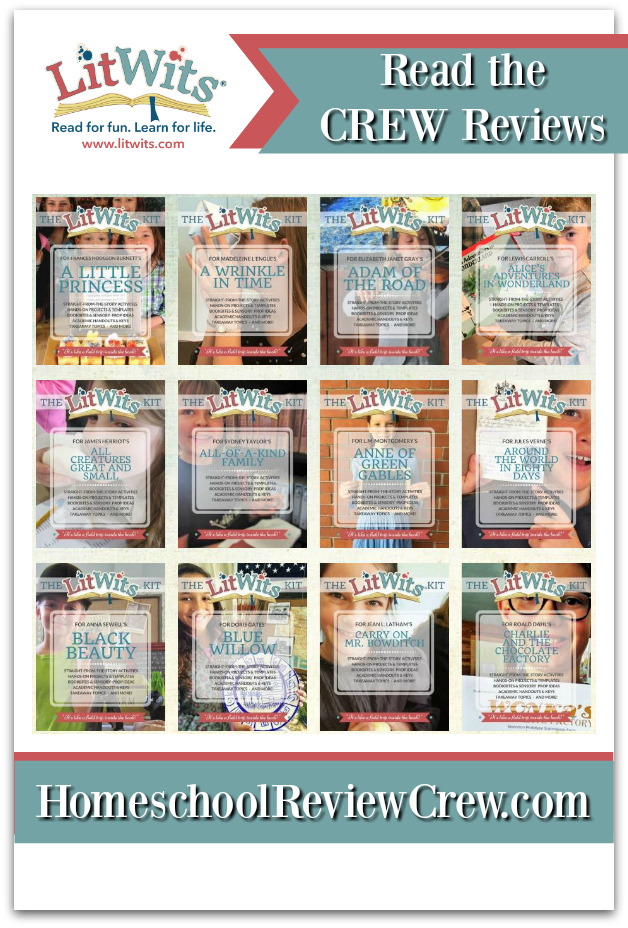
LitWits Kits {LitWits Reviews}
Crew Disclaimer

Tuesday, November 19, 2019

Littles Learning Link Up: Paper Plate Mayflower Craft


Littles Learning Link Up is now on Friday!!

Each month you will find:
  • A seasonal round-up (usually toward the beginning of the month)
  • Posts where I share what I have been up to with my elementary-age children and the preschoolers I work with at our homeschool co-op (including occasional highlight posts where I share how we used ideas that have been linked up here on Littles Learning Link Up).
Each week, I will host a link up, where you can share either what you have been up to recently, or old posts that may go with the theme.  Feel free to link up more than one post.

Each week I will continue to feature a couple of posts from those that have been linked up. 

I hope you will continue to share your wonderful posts, and I hope you will find something new to try with your child(ren).

It would be great for everyone to stop by and visit the other linked-up posts as well. Check them out, leave some comments, pin those that interest you. Let's make this a real party and socialize with each other.

Here's a peek at what we have been up to in our homeschool.

We have finished reading Charlie and the Chocolate Factory and now have some educational worksheets from The LitWits Kits that we are using as a part of the review. Plus we are watching both movies so we can compare and contrast. 

We are finishing up our review year and I am so relieved it is winding down. I only have one more review left. And then we have a break. I will find out if I am coming back for next year with the Homeschool Review Crew in a little bit. Plus, I will be posting about the Blue Ribbon Rewards soon. 

Moving on to our craft.

We have been focusing on Thanksgiving in our prek/k co-op class. 

First we reviewed the months of the year, and talked about the holiday coming up this month. Thanksgiving. Then I read a book that explained what Thanksgiving is. We learned that the people who came over on the Mayflower were known as Pilgrims, and people tend to call the native people who lived here, Indians. I came up with a song based off of a song we used to sing at the Montessori. 
1 Little, 2 Little, 3 Little Indians. This one, I called 1 Little, 2 Little, 3 Little Pilgrims.

Here are the words. 

1 Little, 2 little, 3 little pilgrims
4 little, 5 little , 6 little pilgrims
7 little, 8 little, 9 little pilgrims
10 little pilgrim boys and girls
(count on fingers)

They jumped in the boat and the boat went sailing
With all those pilgrim boys and girls
(cup one hand in front of you and put fingers together on the other hand and have them jump into the "boat" then move both hands forward. Repeat for each line)

They sailed across the ocean and came to a new land
All those pilgrim boys and girls
(move your boats forward and then show the new land by putting hands together, facing downward, and move them apart. Again, repeat for each line)

They had troubles but they trusted in God
All those pilgrim boys and girls
(Shake finger several times, then put hands in prayer position and lift. Repeat)

They made friends with some helpful indians
All those pilgrim boys and girls
(Grasp both hands in front of you and move up and down as if shaking hands. Repeat)

They had a feast and we call it Thanksgiving
Pilgrim and indian boys and girls.
(Pretend to be eating food.)

Then we made a Paper Plate Mayflower. I used an idea I had used way back when Tabitha and Amelia were preschoolers, and I added some printable parts from A Little Pinch of Perfect.


You will need:

Plain white paper plates
Craft sticks
The printables from A Little Pinch of Perfect (or create your own sails and leave off the fold-over info)
Acrylic paint (Blue and Brown)
Paintbrushes
White Glue
Brown construction paper (for printing out the info about the Mayflower to glue on)

All I had to do in preparation for this craft was print and cut out the printables and cut some paper plates in half. Each child needs a whole plate and a half a plate.

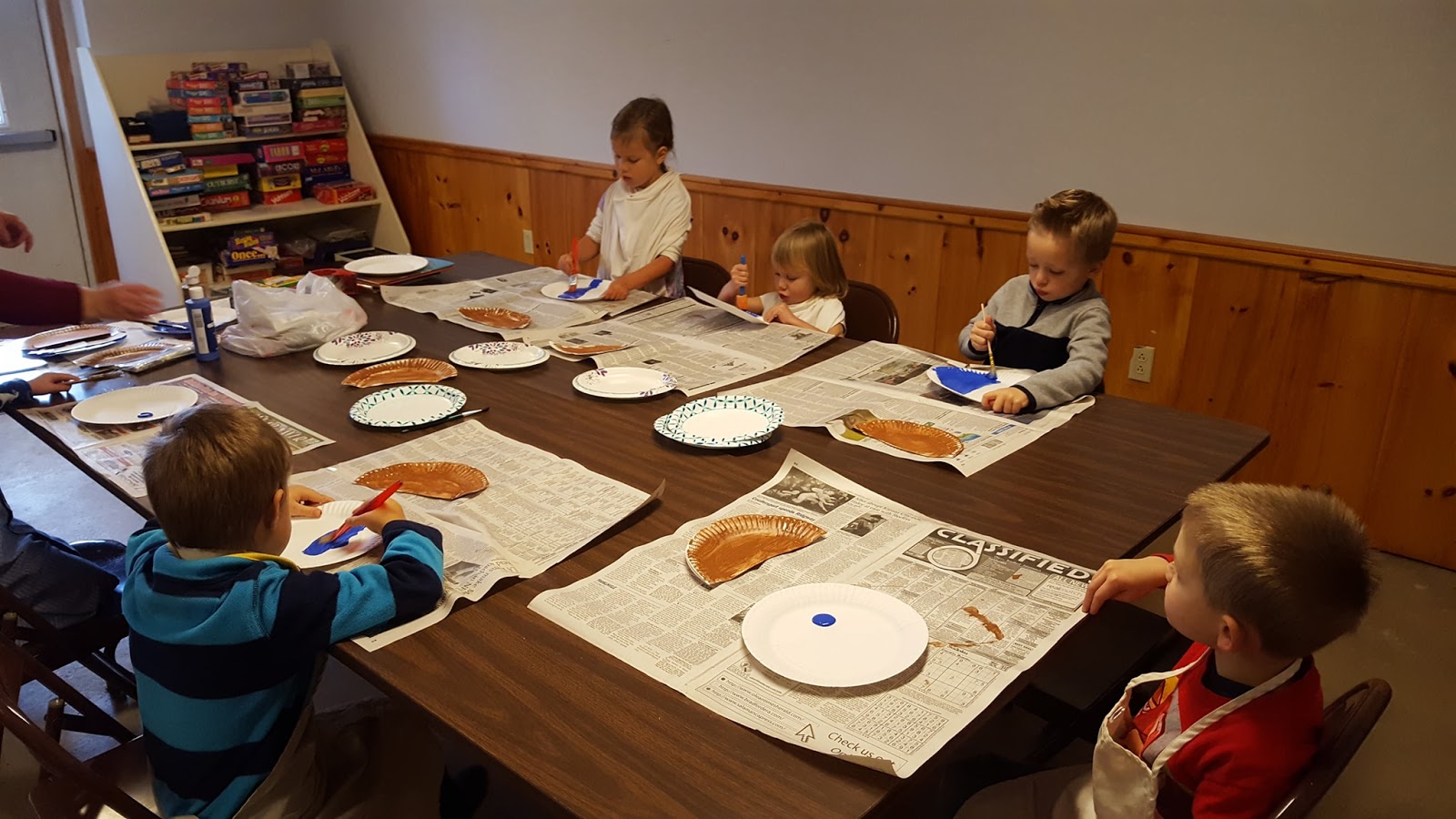
The first thing I had the children do was paint the half a plate brown and then paint half of the whole plate blue (for the sky).


I just put a little paint on the paper plates and had them spread it around with the paintbrush, giving them more if needed. It eliminated the need for separate paint cups.


We then set them to dry while they went to snack and gym time.


When they came back the plates were dry. They glued the brown half-plate onto the white half of the whole plate.


Then I had them put white glue on the bottom of 4 craft sticks and put them down between the plates for the masts.


Then they glued on the sails.


We then talked about the information on the fold-over page. After that we glued it on to the front.


Tada


And these are the books we read.

The first one to help the children understand what Thanksgiving is.


And these two because they incorporated the counting that we had in the song.


Let's take a look at that review schedule real quick:

Last week I posted my review of the new books from Kregel Publications, the Goldtown Beginnings books featuring Jem Coulter. This week I am sharing reviews of some books from Mattie Richardson,  and Elephant Learning Math Academy. And next week you will find the review for LitWits Kits.

Here are some things I would like to share with you:


Now onto:
Littles Learning Link Up Features

On my last Littles Learning Link Up post, there was only 1 wonderful post linked up. 

Please, don't forget to stop by other posts that are linked up. See what catches your eye, stop by, pin the post to a relevant board, and perhaps leave a comment to let the author of the blog know you have been by for a visit. I know I appreciate others commenting and letting me know they have read my posts, so I am sure others do too.

Here's this week's featured post is:


Homegrown Adventures shared Albuquerque, New Mexico Road Trip
.
Join the Party!

I would love to have you join in this week! What sort of activities do you do with your young children? Do you have some favorite activities you would like to share? I invite you to link up below. I will be pinning posts on one of my relevant boards, and I would love to feature some of the activities each week from what is linked up.

Please know I may share a picture from your post and link back to it, along with sharing how we used your idea in our school time. By linking up you are giving me permission to use a picture from your post. I will ALWAYS give credit and link back. Additionally, if you choose to try out any of the ideas with your child, please make sure you give credit where credit is due.

Linky will be open through Monday night, to give me time to check out all the posts and get the Features organized. Please take the time to visit some of the other wonderful posts linked up.

No button currently, and there won't be one until I can figure it out seeing as Photobucket has changed things. Feel free to still share the picture in place of the button. Just link it to my Littles Learning Link Up permalink please.


I am sharing over at

Homeschool Coffee Break


You are invited to the Inlinkz link party!
Click here to enter

Thursday, November 14, 2019

Working on Math with Elephant Learning Math Academy {A Homeschool Review Crew Review}


We had the opportunity to try out a different online math program these past two and a half months. I chose to have Harold and Hannah use Elephant Learning Math Academy, one of our newest review products from the Homeschool Review Crew. Though it can be used by children as young as 2 ranging all the way up to 16 year olds, the older girls chose not to try the program out. I thought we would give it a try as I was curious if it would show me if the children had any areas they were struggling in, plus it was a chance to try something different.


We were given a 12 month subscription to this online program. Elephant Learning guarantees that your child will learn at least 1 year of math in 3 months as long as the program is used 30 minutes a week. Yes, that isn't a typo. They really only require a child to work 30 minutes a week. Personally, I wanted my children working a bit longer, so I wanted them to work 20 minutes a day for at least 3 days a week. 

When a child first gets on the program, he or she is assessed in their skills. Though to the child it doesn't look any different than the activities they will continue working on throughout the program.  The student's work is analyzed and the program assigns an Elephant Age to the child and gives the child exercises in the areas that he or she needs to work in. 

Let's take a look at what the children have experienced with the program.

Once a child is logged in, they come to their home screen.


This shows an overview of their progress as well as their avatar and a look at how much they have played on the current day. As you can see, Harold's Elephant Age has increased from 5.9 to 9.5 since beginning the program almost three months ago. The circle charts on the bottom right show the percentage complete in each topic the child has been working on. 

Here's a look at Hannah's home screen:


Her Elephant Age has increased from 7.6 to 9.8. 

We can also check out the Playtime Analysis to see how long the child has worked each week. As I mentioned, the recommended weekly time on the program is 30 minutes. Though there were a couple of times the children didn't have a chance to get their work done due to our schedule, their weekly average is still higher than the recommended 30 minutes a week. 


We can also look back on any time range to see how the child performed on every game.


I can go back and see the exact kinds of problems my children were assigned during their time on Elephant Learning. I can see the timestamps, whether the passed, failed, or passed with a milestone, and how long it took them on each game. I can change the range of dates to see the different topics they worked on each week. Which I really appreciate, seeing as the children feel they are always doing the same thing, yet I can see how they have advanced in what they have been working on. For example, when Harold first started, he was working in the following topics:
  • Base 10 to 100
  • Skip Counting
  • Addition-Subtraction: Comparison
  • Addition-Subtraction: Count On
  • Number Composition
  • Addition-Subtraction to 20
  • Decomposing Numbers
  • Counting to 20 in the line
And this week he is working on:
  • Compare Multiply
  • Find percentage of total using number line
  • Division
  • Introduction to Equivalent Fractions
  • Introduction to the Language of Percentages
  • Representation of Fractions
  • Multiplication-Division: Arrays
  • Percentage of a collection
  • Estimate Numbers to 1000
  • Multiplication-Division: Groups 
  • Introduction to the Language of Decimals

And when Hannah first started she was working in the following topics:
  • Counting to 50 in the line
  • Skip counting to 20 in the line
  • Addition Subtraction: Count On
  • Decomposing Numbers
  • Addition Subtraction to 20
  • Number Composition
  • Skip Count to 10 in the line
  • Base 10 to 100
  • Counting to 20 in the line
  • Skip Counting
And this week she is working on:
  • Multiplication in the line
  • Percentage of a Collection
  • Find percentage of total using the number line
  • Division
  • Understanding fractions using areas 1
  • Division
  • Understanding fractions using collection
  • Compare Multiply
  • Estimate Numbers to 1000
  • Multiplication Division: Arrays
So, though the games feel the same, they are working on harder skills now than they were when they began. 

In order to get to their course work, they just need to click that "Continue Coursework" on the home screen.

That brings them to this screen, where they can choose their theme for the day.


Here's a clearer look at the themes, though it is only a fraction of them.


At first we thought that there would be different activities in the different themes. However, we learned that the activities will be the same, the animated graphics will just change. For example, in the following screenshots, Harold was working in the tiger cub theme.


The games all use the tiger cub graphic in different ways.


Here he just had to click on the spot on the number line he thought was correct and click "OK."


The text at the top helps explain what is being learned.


Even though the next screen shot looks the same, the program had moved on to having Harold work with fractions. I thought this was neat because the student can see the relationship between percents and fractions.


The child can move the graphics around the screen if they need to, in order to figure out the answer. Sometimes Harold needs to move them, other times he doesn't, such as in the following problem.


The program then showed him each group.


The problems get a bit harder as he goes along.


Here's a quick look at a different theme. This is one Hannah was using the other day.


The fruits at the left side of the screen show the child how far along in each subject they are. The fruit will go from clear to filled in.


Though the child can choose which theme to use, they have no control over what activities they are going to work in each day. The program has evaluated what the child needs to work on each day, and that is what they work on. I have noticed, on the "History" information, that if a child fails in a game, they are then given the same game later on. Usually the children pass the next time. 

So, what did we think of Elephant Learning Math Academy?

Honestly, I'm torn. I think it is a pretty good program that allows a child to work on topics that need to be worked on. At least according to the way the program analyzes the information. Of course, it can't really take into account if a child is not trying their hardest because they are bored. And, unfortunately, Harold and Hannah have been complaining that they really don't want to use Elephant Learning because there is too much repetition and they are bored. As I have mentioned above, when I looked into what they have been learning, the topics have advanced in difficulty. However, because the "games" are so similar, they feel they are doing the same thing over and over. And when they don't really understand a concept, they feel they aren't getting the instruction that they need in order to fully understand what they are supposed to do. 

Have the children been learning. Well, I have to admit they have been, as their graphs show they have improved since beginning the program. Though I do believe they both placed lower than what they should have. I mean, Hannah took her standardized tests last year and was right on, or above, grade level. Yet her graph shows that her Elephant Age was 2 years younger than what she is. I don't know if part of that was that they were skipping problems in the assessment because they figured if they knew it they didn't have to do it, which is the exact opposite of how it is supposed to work. They are only supposed to skip if they don't know the answer. So, it is possible that they began at a lower age than what they should have, which meant they were working on topics on levels they were already proficient at, which would have bored them from the start. I'm not exactly sure. I do wish there was a way to see the results of the specific questions asked in the assessment. It just seems they both started at a lower age than what they should have. 

That said, even if they had started a bit higher, I admit they have both improved since the beginning. Harold more than Hannah, as he is now at a 9.5 Elephant Age and he is only 7. Hannah on the other hand has an Elephant Age that is close to her real age. 

While Elephant Learning does seem to be a great program where children can improve their math skills, it sadly hasn't been a favorite of my children. There main complaint is that it is boring because of the constant repetition.

You can find Elephant Learning on Facebook, Pinterest, YouTube, and Instagram.

Don't forget to click on the banner below to see what my fellow Crew Mates thought of Elephant Learning Math Academy.


Elephant Learning Math Academy Subscription {Elephant Learning Math Academy Reviews}
Crew Disclaimer